
_edited.png)

Dance Floor Lighting: Your Complete Party Planning Guide
- Terriffics Entertainment

- 12 minutes ago
- 12 min read
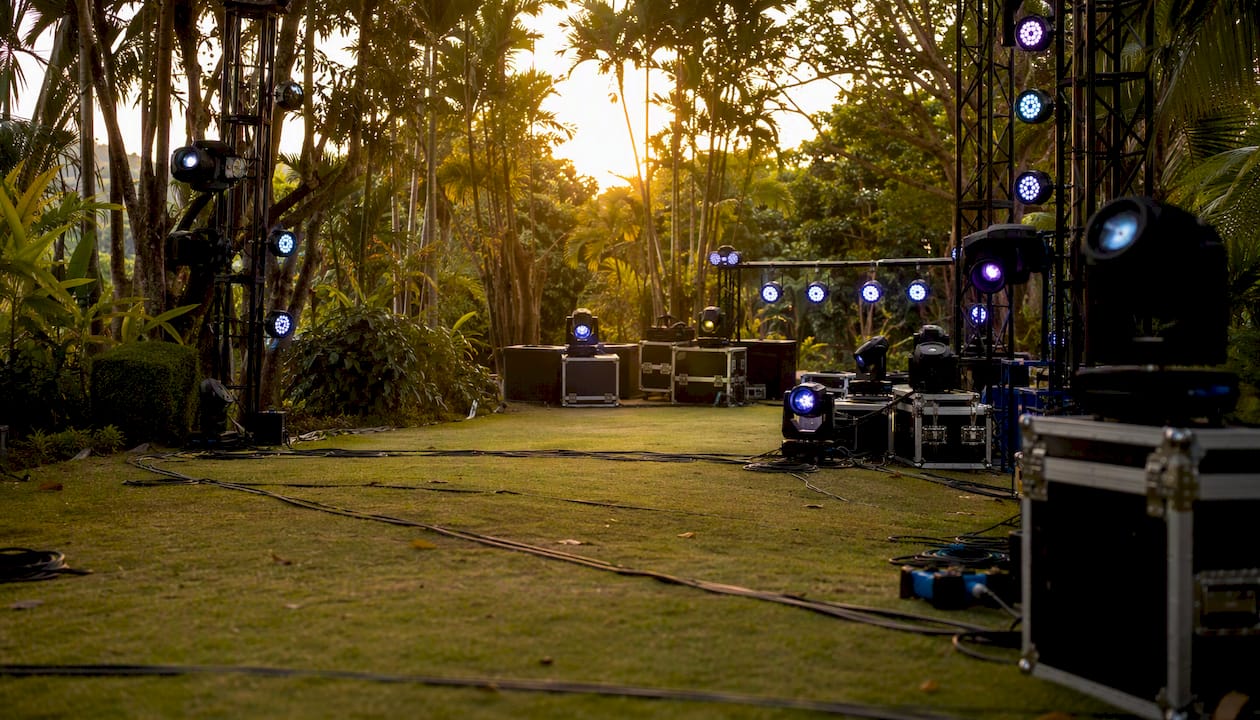
For most weddings and private parties, renting a layered, DMX-controlled lighting package that includes wash lights, moving heads, and an LED dance floor delivers the best balance of visual impact, cost, and on-site safety. You get professional-grade gear, a trained tech who programs scenes to match your event timeline, and none of the storage or maintenance headaches that come with owning equipment. Lighting professionals recommend layering fixtures rather than chasing brightness with a single powerful unit, and that approach is exactly what separates a memorable dance floor from a blinding one.
Here is what a smart rental package looks like in practice:
Wash lights (LED pars or LED bars) flood the floor with even color coverage
Moving heads add dynamic beams, spots, and sweeping effects timed to the music
Feature fixture such as LED dance floor panels or starlight panels create the visual centerpiece guests photograph all night
Uplights frame the room perimeter and set the overall mood between sets
DMX controller with pre-programmed scenes ties everything together so transitions feel intentional, not random
Fixtures rated IP65 or higher handle outdoor humidity and light rain, which matters for open-air venues on Oahu. If you are planning an event on the island, Terrifficsentertainment offers rental packages that include setup, DMX programming, and teardown so you can focus on the celebration.
Pro Tip: Request a scene preview from your rental vendor before the event day. Seeing the dinner wash, first-dance scene, and party-drop effect in advance lets you adjust colors and timing without any surprises in front of your guests.
Key Takeaways
Renting a layered, DMX-programmed lighting package with an on-site tech is the most reliable path to a great dance floor for weddings and private parties.
Point | Details |
Rent a layered package | Wash lights, moving heads, and a feature fixture together outperform any single bright unit. |
Prioritize DMX programming | Pre-built scenes timed to your event flow beat sound-activated modes for every key moment. |
Plan power and safety early | Confirm breaker capacity, GFCI protection, and safety bonds before load-in day. |
LED floors are high-impact | A 12×12 ft LED dance floor panel system creates a visual centerpiece guests photograph all night. |
Terrifficsentertainment on Oahu | Bundles setup, DMX programming, safety hardware, and teardown into one flat-rate local package. |
Table of Contents
What types of dance floor lighting fixtures do you actually need?
Not every fixture belongs at every event. Knowing what each one does helps you build a package that matches your vibe and venue size, rather than paying for gear that sits unused in a corner.
Wedding lighting guides consistently list LED floors, moving heads, fairy lights, gobos, and uplighting as the top choices, and each one serves a distinct purpose.
LED pars and pixel-controlled bars are the workhorses. They wash the floor and walls in solid color or slow-shifting gradients. Affordable, energy-efficient, and easy to position, they belong in almost every package.
Moving head lights come in three main types: beam (tight, laser-like shafts), spot (sharp gobo projections), and wash (wide, soft color floods). A beam mover creates the dramatic sweeping effects you see at high-energy party drops. A wash mover softens the room during dinner or a romantic slow dance.
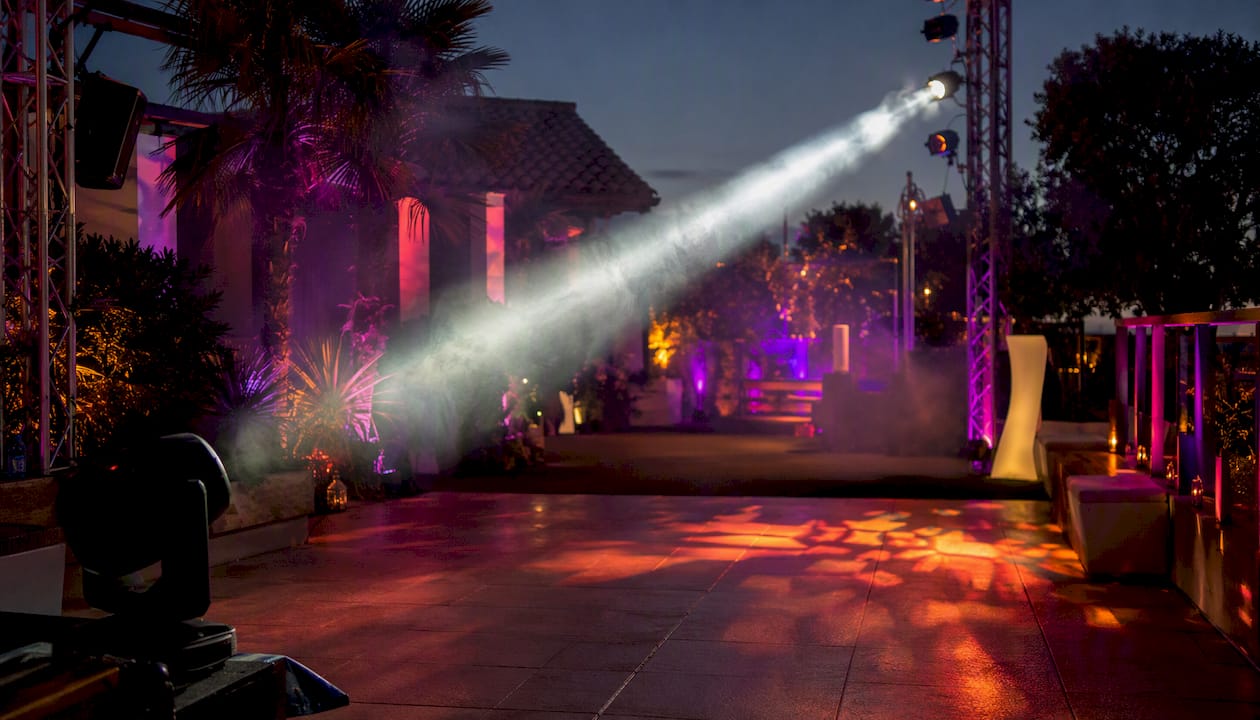
Gobos and spotlights project custom patterns, monograms, or logos onto the floor or a wall. They are the go-to for personalized wedding looks and branded corporate events. A simple gobo swap can turn a generic ballroom into something that feels designed specifically for your night.
Disco/mirror ball with pinspots is a classic for good reason. Two pinspot beams aimed at a spinning mirror ball scatter hundreds of moving dots across the room. It costs very little and works beautifully for school dances, retro-themed parties, and nostalgic first-dance moments.
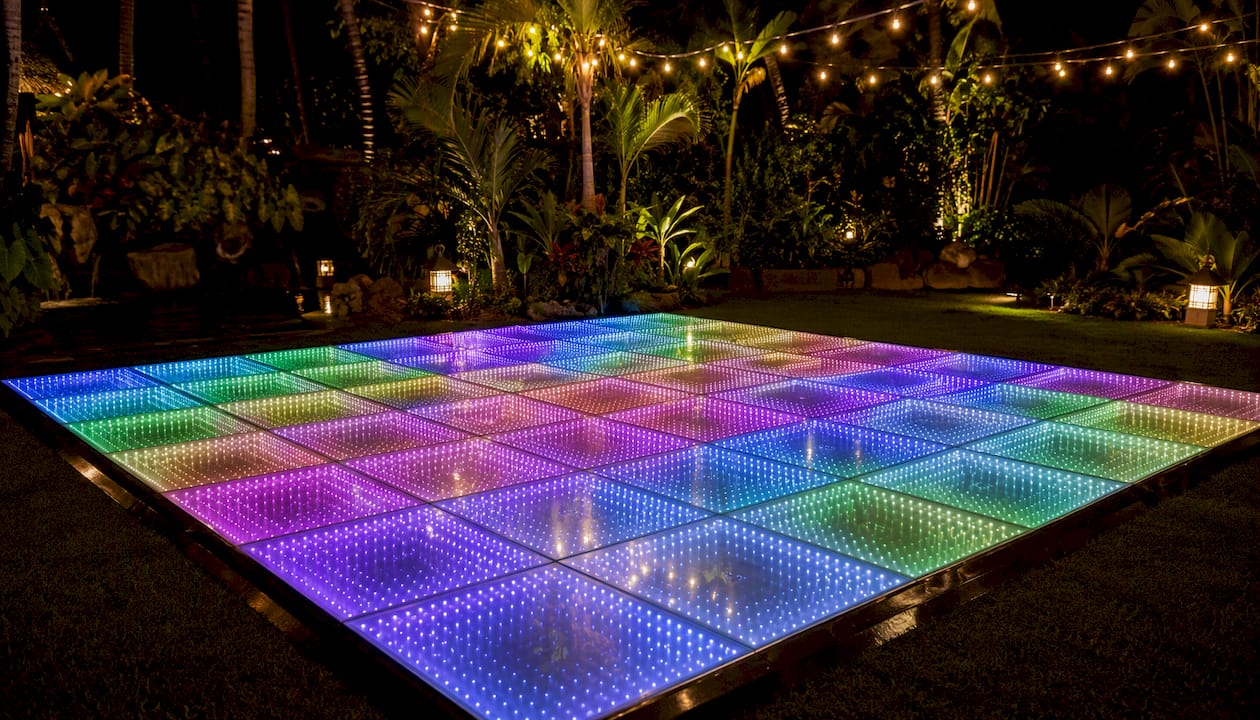
LED dance floor panels and starlight panels sit on the ground and become the dance surface itself. Guests literally stand on light. These are high-impact centerpieces that photograph exceptionally well and work for weddings, proms, and upscale corporate events.
Effect lights such as derby lights and bee-eye fixtures produce rapid multi-beam patterns that energize a crowd fast. Use them sparingly during peak party moments rather than running them all night.
Lasers can look spectacular, but they require proper safety clearances and should never be aimed at eye level. If a vendor offers lasers, confirm they are Class 3R or lower and programmed to scan rather than hold a static beam.
Uplights and festoon/string lights work differently from dynamic dance floor lighting. Uplights are generally static and accent architectural features like columns, drapes, or walls to set the room tone. String lights add warmth and texture overhead without competing with the floor action.
Quick sizing rule of thumb:
Small venues (under 1,000 sq ft): 2–4 flexible fixtures cover the floor well
Medium venues (1,000–3,000 sq ft): 4–8 layered fixtures with at least one moving head
Large venues (3,000+ sq ft): multiple moving heads, truss or flown fixtures, and a feature floor element
For a lighting setup breakdown by event type, Terrifficsentertainment’s blog covers specific configurations for weddings, private parties, and corporate gatherings on Oahu.
Pro Tip: For corporate events where branding matters, swap the standard gobo for a custom logo gobo. It projects your company name or event theme directly onto the dance floor or a feature wall, and it costs far less than a custom backdrop.
How do you pick the right fixtures or rental package?
The right package depends on your venue, your budget, and how much control you want over the final look. Work through these criteria before you contact any vendor.
Decision checklist
Venue size and ceiling height — Low ceilings (under 10 ft) limit moving head travel and truss height. Measure before you commit to a rig.
Power availability — Know your breaker capacity. A typical mid-tier package draws 1,500–3,000 watts. Confirm with the venue before load-in.
Load-in access — Narrow hallways, stairs, or no freight elevator affect which fixtures and flight cases can physically get to the room.
Indoor vs. outdoor — Outdoor events need fixtures rated IP65 or higher and may require a generator if shore power is unavailable.
Photography needs — Photographers prefer warmer, steadier light during key moments. Ask your vendor to program a “photo-safe” scene for the first dance and cake cutting.
Budget band — Decide your range before you talk to vendors. It shapes which tier of package is realistic and prevents scope creep.
Desired effects — Romantic and soft? High-energy party? Branded corporate? Your answer drives fixture selection more than any other factor.
Questions to ask every vendor
Do you provide DMX programming and an on-site technician for the full event?
What are the IP ratings on your outdoor fixtures?
Are any fixtures battery-operated, and can you use wireless DMX?
What is the total power draw, and do you provide a cable plan for the venue?
Do you include truss, towers, and rated safety hardware (safety bonds, clamps)?
Can I preview scenes before the event, and can you create a custom gobo?
Red flags to watch for
Vendor cannot provide wattage or power specs in writing
No on-site tech or programming — only sound-activated mode
Mounting hardware is unspecified or “we’ll figure it out on the day”
No mention of safety bonds for any truss or flown fixtures
Package price seems unusually low with no itemized fixture list
Fewer, higher-quality fixtures with strong programming consistently outperform a cluttered setup of cheap effect lights. A vendor who leads with fixture count rather than programming capability is worth a second look.
Should you rent or buy your party lighting?
For most event planners and party hosts, renting wins on almost every dimension. Here is how the two paths compare.
Rent when:
The event is a one-time or occasional occasion (wedding, graduation, milestone birthday)
You have no storage space for flight cases and truss
You want professional setup, programming, and teardown included
You need access to high-end fixtures (LED dance floors, moving heads) without the capital outlay
You want to try a fixture type before committing to a purchase
Buy when:
You host events monthly or more frequently at the same venue
You want full creative control and the ability to program at any time
You need a single persistent fixture type, such as uplights for a recurring venue or LED strips for a permanent installation
You have the technical knowledge to maintain and repair gear yourself
Rough U.S. rental cost bands
Basic package (2 LED pars + 2 moving heads, sound-activated): $200–$400 per event. Good for small birthday parties and casual gatherings.
Mid-tier package (4–6 fixtures including moving heads + uplighting + DMX programming): $500–$1,200 per event. The sweet spot for most weddings and private parties.
Premium package (LED dance floor panels + DMX programmer + multiple movers + uplights + on-site tech): $1,500–$3,500+ per event. Appropriate for large weddings, proms, and corporate events.
Buying equivalent mid-tier gear outright typically runs $3,000–$8,000 for quality fixtures, plus ongoing maintenance, storage, and the learning curve of DMX programming. For a host who throws one or two events per year, the math rarely favors buying.
Factor | Renting | Buying |
Upfront cost | Low (per-event fee) | High ($3,000–$8,000+ for mid-tier) |
Maintenance | Vendor’s responsibility | Your responsibility |
Storage | None required | Flight cases, dry storage needed |
Technical support | On-site tech often included | Self-managed |
Access to latest gear | Yes, vendor updates inventory | Limited to what you own |
Depreciation | No asset risk | Fixtures lose value over time |
For small private events on Oahu, Terrifficsentertainment’s private party packages bundle lighting, sound, and setup into a single flat-rate booking, which removes the guesswork from budgeting.
What are LED dance floors and how do they work?
An LED dance floor is a modular system of interlocking panels that guests dance on directly. Each panel contains LED elements that display color, patterns, or animated graphics controlled via DMX or a proprietary pixel-mapping system. LED dance floors are available in multiple panel sizes and footprints, and they support RGB or RGBW color control for full-spectrum effects.
Common assembled footprints run from compact 6×6 ft configurations for intimate first-dance moments up to 20×20 ft or larger for ballrooms and outdoor receptions. The modular design means panels travel in flight cases, interlock on-site without tools, and can be configured to fit irregular spaces.
Installation basics:
Panels interlock edge-to-edge on a flat, level surface
DMX signal runs through the panel chain or via a wireless DMX receiver
Outdoor installations require panels rated IP65 or higher and a dry, stable subfloor
Elevated or outdoor setups may need a load-bearing understructure; confirm weight ratings with the venue
Total power draw varies by panel count; a 12×12 ft floor typically draws 1,500–2,500 watts
LED dance floor panel features to check
Feature | What to look for |
Control type | DMX or proprietary pixel mapping |
Color system | RGB or RGBW (RGBW gives cleaner whites) |
IP rating | IP65 minimum for outdoor use |
Panel load rating | 1,000 lbs per panel or higher for safety |
Heat output | Low-heat LED elements for long-event comfort |
Connector type | Locking power and data connectors (no loose plugs) |
Warranty/repair | Vendor-backed repair policy or on-site spare panels |
LED panels prioritize low heat output and long LED life, which simplifies multi-hour events and reduces mid-event maintenance. Ask your vendor whether they carry spare panels on-site in case of a connector failure during the event.
Why does DMX programming matter more than fixture count?
The short answer: a well-programmed set of four fixtures will outperform a poorly run set of twelve every time. Programmed DMX scenes synchronized to music tempo create a more cohesive guest experience than generic sound-activated modes, which react to volume rather than musical structure and can feel chaotic during emotional moments like a first dance.
The layered approach
Build your lighting design in three layers:
Base wash — LED pars or bars set to a warm or neutral tone cover the entire floor evenly. This is your foundation and the layer that stays on all night.
Mid layer — Moving heads and effect lights add movement, beams, and color shifts. Program these to change with song sections, not just beat hits.
Feature fixture — The LED dance floor, gobo projection, or mirror ball is the focal point. It should activate at key moments (party drop, first dance reveal) rather than run continuously.
Sample DMX scene list
Dinner/cocktail hour: Warm amber wash, no movement, soft fade transitions
First dance: Single-color spot on couple, slow moving head sweep at low intensity, LED floor in soft white or blush
Party drop: Full color wash, fast moving head movement, LED floor in animated pattern, effect lights active
Cool-down/slow song: Blue or purple wash, minimal movement, LED floor in slow pulse
Limit each scene to 2–4 active colors. Guides consistently recommend a restrained palette per scene to avoid visual clutter that distracts from the moment and photographs poorly.
Battery-powered fixtures and wireless DMX are practical solutions for outdoor venues or spaces without accessible power runs. They eliminate long cable runs across the dance area, speed up setup and teardown, and reduce tripping hazards for guests.
Pro Tip: Program a dedicated “photo-safe” scene for the cake cutting and bouquet toss. A steady, warm wash with no moving beams gives photographers a clean, consistent exposure and produces far better images than a mid-party color cycle.
What does a day-of setup timeline look like?
Good lighting requires time. Rushing the setup is the most common reason a rig looks unfinished or unsafe by the time guests arrive. Here is a realistic timeline for a 6-hour wedding reception.
Sample timeline
T-4 hours: Load-in begins — Fixtures, flight cases, truss, and cable runs arrive. Venue walkthrough to confirm power locations and mounting points.
T-3 hours: Rigging and truss assembly — Truss or tower assembly with safety bonds and rated clamps on all flown fixtures.
T-2.5 hours: Cable runs and power distro — All cables taped or covered, GFCI protection on outdoor circuits, breaker load confirmed.
T-2 hours: DMX patch and scene test — Address all fixtures, load scene list, test each scene at full output.
T-1 hour: Dress rehearsal — Run first-dance scene, party-drop scene, and cool-down scene with the DJ or event coordinator present.
T-30 minutes: Final safety check and standby — All cables secured, fixtures at operating temperature, tech on standby.
Power and safety checklist
Confirmed breaker capacity in writing from the venue
GFCI protection on all outdoor or wet-area circuits
All cable runs taped, covered, or routed away from foot traffic
Fixture-to-sprinkler clearance confirmed (minimum 18 inches in most venues)
Safety bonds on every truss-mounted or flown fixture
Heat clearance around fixtures confirmed (no drapes or fabric within manufacturer spec)
Pre-event contacts and logistics
Venue contact name and direct phone number
Confirmed load-in window and parking/freight access
Power specs sheet shared with venue manager
Equipment inventory list signed off by tech
Spare bulbs, fuses, and a spare DMX cable in the kit
On-site tech contact number shared with event coordinator
Battery-powered fixtures and wireless DMX cut setup time significantly for outdoor Oahu events where running power cables across a lanai or open lawn creates safety risks. For venue-specific setup notes, Terrifficsentertainment’s Oahu event lighting guide covers local venue considerations in detail.
What do realistic lighting packages cost in the U.S.?
Pricing varies by market, but here are representative ranges for U.S. events in 2026. Oahu events may carry a modest travel and labor premium given island logistics.
Basic rental ($200–$400): 2 LED pars + 2 moving heads, sound-activated control, no on-site tech. Works for casual birthday parties and small gatherings under 50 guests.
Mid-tier rental ($500–$1,200): 4–6 fixtures including moving heads, uplighting, and DMX programming with an on-site tech for the first two hours. The right fit for most weddings and private parties.
Premium rental ($1,500–$3,500+): LED dance floor panels + DMX programmer + multiple moving heads + full uplighting package + on-site tech for the full event. Appropriate for large weddings, proms, and corporate events.
Common add-ons and their price impact
LED dance floor per sq ft/day: $8–$15 per sq ft depending on panel type and configuration
Additional moving head: $75–$150 per unit per event
Wireless DMX module: $50–$100 per module
Custom gobo/monogram: $50–$150 for fabrication, one-time cost
On-site tech beyond package hours: $75–$150 per additional hour
Outdoor weatherproofing (IP65 fixtures, generator): $200–$600 depending on site
For Oahu events, local factors include permit requirements for certain outdoor venues, travel time between Kapolei and the event site, and the availability of island-based repair support if a fixture fails mid-event. Terrifficsentertainment bundles setup, programming, and teardown into its packages, which removes the hidden labor costs that inflate mainland quotes. Their wedding DJ lighting packages show specific configurations and what is included at each tier.
A note from the team at Terrifficsentertainment
We have set up lighting for weddings, graduations, school dances, and corporate events across Oahu, and the pattern we see most often is this: clients who rent a layered, programmed package walk away happy. Clients who cut corners on programming or skip the on-site tech spend the night adjusting fixtures themselves instead of enjoying the event.
The most common request we get after the fact? “Can you add more to the dance floor?” That is why we recommend starting with at least a mid-tier package that includes moving heads and a feature fixture, even for smaller events. A 12×12 ft LED floor at a 60-person wedding creates a moment guests talk about for years.
We prioritize safety compliance on every setup, including rated hardware, GFCI protection, and safety bonds on all flown fixtures. Our DMX programming is done in advance and tested on-site before guests arrive, so the lighting runs exactly as planned from the first song to the last.
Terrifficsentertainment brings your dance floor to life on Oahu
When you book a lighting package with Terrifficsentertainment, you get more than gear. You get a local team that knows Oahu venues, handles the full setup and teardown, programs your scenes in advance, and stays on-site to manage the rig all night. No guesswork, no last-minute cable scrambles, and no fixtures left blinking in the wrong color during your first dance.
Our packages include DMX-programmed scenes, safety hardware, and LED dance floor options for weddings, private parties, graduations, and corporate events across the island. We mix and match lighting with DJ sound, karaoke, and our AI-powered photobooth so you can build one complete entertainment package for your event.
Ready to see what your dance floor could look like? Browse our event gallery for real Oahu setups, or get a quote for your event date and we will put together a package that fits your venue, your vibe, and your budget.
Sources
These resources cover the technical and creative sides of dance floor lighting in more depth.
Recommended
Comments