
_edited.png)

DJ Event Planning Tips for Unforgettable Oahu Events


Planning a DJ-hosted event in Oahu sounds exciting until the logistics hit you all at once. Which DJ do you book? What gear do they need? How early is too early to start? These are the questions that separate a smooth celebration from a stressful one. Whether you’re organizing a wedding in Kapolei, a birthday bash in Honolulu, or a graduation party on the North Shore, the right DJ event planning tips will save you time, money, and a lot of last-minute headaches.
Table of Contents
Key takeaways
Point | Details |
Book early for peak season | Secure your DJ 12 to 18 months out for popular May through October dates. |
Use a detailed contract | Contracts must include equipment, overtime rates, and backup plans to prevent disputes. |
Share your timeline early | Send a finalized run-of-show document to your DJ 30 to 60 days before the event. |
Confirm technical requirements | Verify power access, noise rules, and equipment needs well before event day. |
Plan for the unexpected | Establish clear protocols for overtime, technical failures, and guest request conflicts. |
1. Start your DJ search earlier than you think
The number one mistake people make when planning a DJ event on Oahu is starting the search too late. Peak season here runs May through October, and Saturdays book up fast in that window. If you want a quality DJ for a summer wedding or a graduation party, start looking 12 to 18 months out.
This isn’t panic planning. It’s just practical. The best DJs on the island have full calendars, and giving yourself that runway means you get to choose from the top of the list instead of whoever is still available.
Use that time wisely. Read reviews, watch videos from past events, ask for referrals from venues, and schedule consultations with at least two or three candidates before committing.
2. Set a realistic budget before you start comparing
DJ pricing on Oahu varies a lot depending on experience, equipment, and event type. As a general benchmark, average DJ costs for weddings run between $1,000 and $2,500, with premium DJs in high-demand markets charging $3,000 to $5,000 or more.
Knowing your budget upfront keeps the search focused. It also helps you understand what you’re actually getting. A lower price might mean fewer hours, basic lighting, or no backup equipment. A higher price often reflects experience, better gear, and a DJ who has handled hundreds of events.
Pro Tip: Ask for an itemized quote that breaks down the cost of hours, equipment, overtime rates, and any add-ons. Transparent pricing protects both you and the DJ from surprise costs down the road.
3. Match the DJ to your event type
Not every DJ is the right fit for every event. A DJ who crushes it at late-night club nights may not have the skills to MC a wedding reception or manage the quiet moments between a ceremony and cocktail hour. Event planning for DJs means thinking carefully about fit, not just availability.
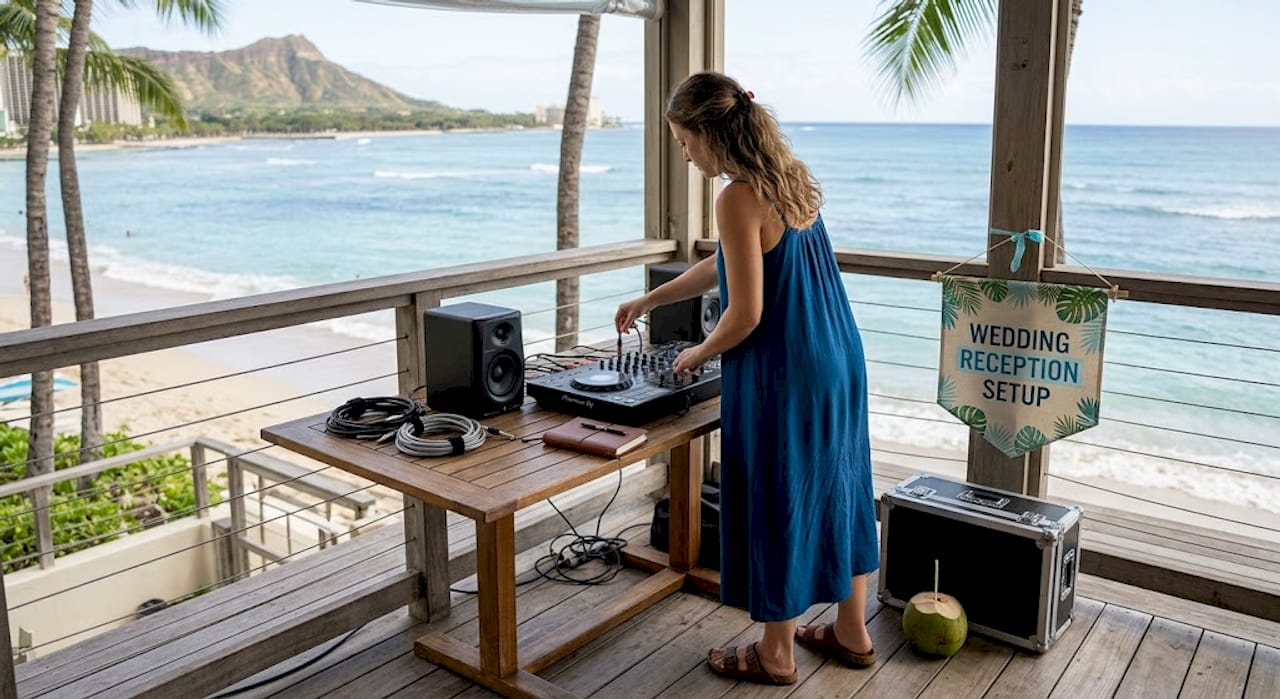
Ask specifically about the DJ’s experience with your type of event. Have they done beach weddings? School graduations? Corporate parties? Can they provide references from similar events?
A local Oahu DJ who knows the venues, the crowd preferences, and the cultural mix of guests here is a genuine advantage. Check out how to choose a trusted DJ specifically for Oahu events to understand what local credibility looks like in practice.
4. Read the contract carefully before signing anything
A contract is not a formality. It’s your protection. Clear contracts reduce disputes and cover every detail you might forget about on a busy event day.
Your contract should explicitly include:
Event date, start time, and end time
Exact location and setup/breakdown windows
Full equipment list with specifications
Overtime rates and how they are triggered
Cancellation and refund terms
Backup plans in case the DJ cannot perform
The backup plan clause is especially critical. Ask what happens if the DJ gets sick or has an emergency. A professional DJ will have an answer ready and will have it documented.
5. Build a music plan that has room to flex
Here’s something most people don’t realize about music planning: a perfect playlist is a myth. The best approach is to prepare roughly three times the amount of music you expect to need, organized into energy blocks so the DJ can read the room and adapt.
Your job as the event host or planner is to give the DJ a strong foundation. That means:
A must-play list of 10 to 15 songs that matter to you or your guests
A do-not-play list of songs that would kill the mood or upset guests
A general vibe description for each phase of the event (arrival, dinner, dancing, wind-down)
Experienced DJs adapt music BPM gradually to manage crowd energy, so trust them to handle transitions once you’ve given them the framework.
Pro Tip: Use a shared Google Doc or a music planning app so you and your DJ can update the list in real time without email chains getting confusing.
6. Share a detailed timeline 30 to 60 days out
This is one of the most overlooked DJ event planning tips. Professional DJs need a planning meeting 30 to 60 days before the event to lock in the timeline, confirm the playlist direction, and align with other vendors.
Your run-of-show document should include:
Guest arrival and welcome music window
Ceremony or program start and end times
Dinner, toasts, or program elements with exact timing
First dance, cake cutting, or other key moments
Dancing block start time and last song timing
A collaborative run-of-show document shared with your DJ, photographer, and caterer keeps everyone on the same page and prevents those awkward silent gaps that guests always notice.
7. Confirm your venue’s technical requirements early
DJ event setup tips often focus on gear, but the venue itself shapes everything. Before you finalize any equipment plan, confirm these details with the venue directly:
Available power outlets and circuit capacity
Table or booth space allocated for the DJ
Indoor versus outdoor setup and weather protection
Audio system compatibility (does the venue have a house system?)
Ceiling height and layout for lighting rigs
Local Oahu venues range from open-air beachside spaces to hotel ballrooms, and each has different requirements. An outdoor setup on a windy North Shore beach has very different needs than a climate-controlled room at a Waikiki hotel.
For a thorough breakdown of what to verify, the event sound system guide covers audio setup requirements in detail.
8. Know the local noise rules
This one surprises a lot of first-time event planners in Oahu. Local noise ordinances often cap decibel levels after 10 or 11 PM, and venues that ignore this risk fines and early shutdowns.
Talk to your venue coordinator about their sound policy. Ask whether there are noise complaints from neighboring properties or whether previous events have had issues. If you’re planning an outdoor event, this matters even more.
Your DJ should already know this. A professional who regularly works Oahu events will factor these limits into their setup and will not max out the volume in ways that jeopardize your event.
9. Verify backup equipment and insurance
Two things that are easy to skip and costly when you do. Backup equipment is non-negotiable for professional DJs. Reliable ones always bring duplicates of critical gear, including speakers, cables, and mixers.
Insurance is equally critical. Many Oahu venues now require a Certificate of Insurance before allowing vendor access. If your DJ cannot produce one, you may find out on the day of the event that they cannot set up. Ask for it during the contracting phase, not the week before.
A comprehensive equipment checklist minimizes disputes by clarifying exactly what is included in the service.
10. Plan for common challenges before they happen
Even the best-planned events hit snags. The difference is how prepared you are when they do. Here are the challenges that come up most often at DJ events on Oahu and how to handle them:
Timeline changes. Guests run late. Speeches go long. Have a buffer built into your timeline and give your DJ permission to adjust music to fill or compress transitions.
Technical issues. A speaker cuts out or a laptop freezes. This is why backup equipment matters. Confirm with your DJ that they have a tested backup ready to go.
Guest song requests. Guests will always request songs. Some will conflict with your do-not-play list. Give your DJ clear authority to decline those requests politely without involving you mid-event.
Energy shifts. A dance floor that empties out is not a DJ failure. It’s a signal. Good DJs read the room and shift the vibe. Let them do their job.
Pro Tip: Agree on overtime terms before the event, not during it. Transparent overtime pricing prevents awkward money conversations when everyone just wants to keep the party going.
11. Use a DJ party planning checklist by phase
Organizing your prep into phases keeps things manageable. Here’s a side-by-side look at proactive versus reactive planning, plus the checklist items that belong in each phase.
Phase | Proactive approach | Reactive approach |
Booking (12+ months out) | Research, vet, and contract a DJ with backup plans | Scramble for availability close to the date |
Preparation (1-2 months out) | Share timeline, playlists, and vendor contacts | Finalize everything the week before |
Event day | DJ arrives early, tests equipment, runs sound check | DJ arrives at start time with no buffer |
During event | Real-time coordination via pre-agreed signals | React to issues as they arise with no plan |
The proactive column is your DJ party planning checklist in action. The key items to confirm before event day: signed contract, COI on file, final timeline shared, must-play and do-not-play lists submitted, and overtime terms documented.
Pro Tip: Tailor your checklist to the scale of your event. A 50-person birthday party needs a simpler checklist than a 200-person wedding reception. Don’t overcomplicate small events.
My honest take on what makes a great DJ event
I’ve helped coordinate a lot of events across Oahu, and the thing that separates a truly great night from a forgettable one almost never comes down to equipment. It comes down to communication.
The clients who have the best outcomes are the ones who give their DJ full context early. They share not just the playlist but the story of the event. Who’s celebrating? What does the crowd look like? Are there elderly grandparents who leave at nine, followed by cousins who want to go until midnight? That context is what lets a great DJ shift gears at the right moment.
What I’ve also learned is that micromanaging the DJ during the event usually backfires. You hired them because they know how to read a room. If you’ve done the upfront work of sharing your vision and a solid timeline, trust them to execute. Step in only when something genuinely needs addressing.
The DJs who really stand out in Oahu are the ones with local knowledge. They know which venues have tricky acoustics, which neighborhoods have noise sensitivity, and how a mixed local and tourist crowd tends to respond to different genres. That local fluency is worth paying for.
— Terriffics
Plan your next Oahu event with Terrifficsentertainment
If you’re ready to put these tips into practice, Terrifficsentertainment makes it easy. We serve the entire island of Oahu from our base in Kapolei, and we specialize in exactly the kind of events you’re planning, whether that’s a wedding, birthday, graduation, or community celebration.
Our DJ, photobooth, and karaoke packages are designed to mix and match, so you get exactly what your event needs without paying for what you don’t. We handle fast setup and teardown, work closely with your venue, and bring backup equipment to every single job. Want to see what a real Oahu celebration looks like with the right entertainment? Browse our event gallery and get inspired. Then reach out to book or get a custom quote. We’re friendly, responsive, and genuinely excited to help you pull off something unforgettable.
FAQ
How far in advance should I book a DJ for an Oahu event?
Book at least 12 to 18 months ahead for peak season dates between May and October. Popular Saturdays fill up fast, and the best local DJs have limited availability.
What should a DJ contract include?
A solid contract covers the event date and times, full equipment list, overtime rates, cancellation terms, and a backup plan. Missing any of these creates room for disputes.
How do I handle guest song requests at my event?
Give your DJ a clear do-not-play list and the authority to decline conflicting requests without involving you. This keeps the flow smooth and keeps you free to enjoy your event.
What technical details should I confirm with my venue before the DJ arrives?
Confirm power access, table space, noise ordinance limits, and whether the venue has a house audio system. Outdoor venues on Oahu also require weather protection planning for equipment.
Do I need to share a timeline with my DJ before the event?
Yes. Share a finalized run-of-show document 30 to 60 days before the event so your DJ can coordinate with photographers, caterers, and other vendors and avoid timing gaps.
Recommended
Comments