
_edited.png)

What Size Generator Do You Need for a DJ Setup?

Size your generator to your total continuous watts plus 20 to 30% headroom, and confirm the surge rating can absorb your speaker and amplifier startup spike. That’s the whole rule. A laptop-and-two-speakers setup usually runs fine on 1,500 to 2,200 watts. A mixer-plus-subwoofer rig with lighting needs 3,000 to 5,000 watts. A multi-speaker festival stage with monitors and effects pushes past 6,000 watts, often across a distributed setup.
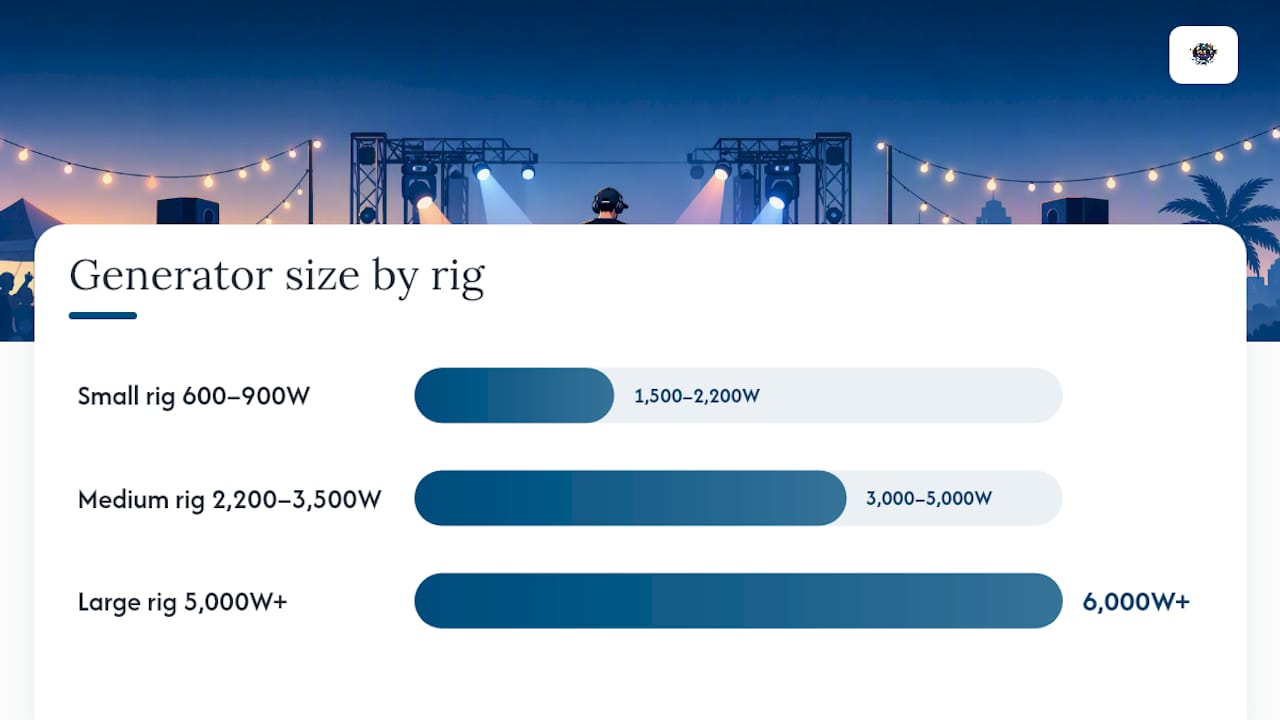
Small rig (laptop, controller, 2 active speakers): 1,500 to 2,200W
Medium rig (mixer, 2 powered speakers, sub, lighting): 3,000 to 5,000W
Large rig (festival-class, multiple subs and monitors): 6,000W+
Pure sine wave inverter generators are the safer bet for laptops and digital mixers, since their clean output closely matches wall power and cuts the risk of audio interference or fried gear.
Pro Tip: Never buy a generator sized to your exact running watts. Speakers and amps draw a hard jolt at power-on, and that jolt is what trips breakers, not the sustained load.
Key Takeaways
Correct generator sizing for a DJ rig requires calculating total continuous watts, adding 20 to 30% headroom, and confirming the surge rating covers speaker and amp startup.
Point | Details |
Calculate continuous watts first | Add up every device’s running wattage before applying any safety margin. |
Add 20 to 30% headroom | This buffer absorbs inrush current from speakers and amps and prevents breaker trips. |
Match rig size to generator range | Small rigs need 1,500 to 2,200W, medium rigs 3,000 to 5,000W, large rigs 6,000W or more. |
Choose pure sine wave for digital gear | Inverter generators protect laptops and mixers from interference and long-term damage. |
Terriffics handles sizing and setup | Our team plans power, distro, and safety for Oahu events so clients skip the wattage math. |
Table of Contents
How to Calculate Generator Size for DJ Equipment
Getting the math right takes five steps, and none of them require an electrician’s license.
Inventory every device. Write down the continuous (running) watts for your controller, mixer, speakers, subs, and lighting. Check the back panel or power supply label for each one, and note any listed surge or peak watts separately.
Convert to watts where needed. Some gear lists amps and volts instead. The formula is simple: Watts = Volts × Amps. A device pulling 5 amps at 120 volts draws 600 watts.
Add up your continuous load. Sum every device’s running watts into one total. This is your baseline number before any safety margin.
Add headroom. Multiply that total by 1.2 to 1.3 to add 20 to 30% headroom. This buffer absorbs inrush current and prevents nuisance breaker trips when speakers and amps fire up simultaneously, a point echoed in most professional DJ generator sizing guidance.
Match a generator to that number. Pick a unit whose continuous (rated) output meets or beats your headroomed total, and whose surge rating comfortably covers your gear’s peak draw.
Here’s a quick example: your rig totals 1,800 continuous watts. Add 25% headroom (1,800 × 1.25 = 2,250 watts), and you need a generator rated at least 2,250W continuous, with a surge rating that can handle a brief spike well above that.
Pro Tip: A Kill-A-Watt meter or similar plug-in wattage tester takes the guesswork out of step one. Plug in each piece of gear before the gig and read the actual draw instead of trusting a printed spec.
Small, Medium, and Large DJ Rig Power Examples
Numbers land differently once you see them applied to a real setup. Here’s how the math plays out across three common rig sizes.
A small setup (laptop, DJ controller, two active speakers) typically totals around 600 to 900 continuous watts. Add headroom for speaker inrush, and a generator in the 1,500 to 2,200 watt range covers it comfortably, matching the general sizing range for entry-level DJ gear.
A medium setup (controller, mixer, two powered speakers, a subwoofer, and modest lighting) usually runs 2,200 to 3,500 continuous watts once lighting fixtures are added. That points to a 3,000 to 5,000 watt generator, with the top end reserved for rigs running haze machines or moving heads.
A large or festival setup (multiple powered speakers, multiple subs, monitors, lighting, and effects) can climb past 5,000 continuous watts fast, and surge demand from several amps firing together makes headroom critical. Plan for 6,000W or more, often split across a generator array with proper distribution.
Setup Size | Sample Gear | Continuous Watts | Recommended Generator |
Small | Laptop, controller, 2 active speakers | ~600–900W | 1,500–2,200W |
Medium | Mixer, 2 powered speakers, sub, lighting | ~2,200–3,500W | 3,000–5,000W |
Large/festival | Multiple speakers, subs, monitors, effects | 5,000W+ | 6,000W+ or distributed array |
Inverter vs Conventional Generators for DJ Gear
An inverter generator produces pure sine wave power, the same clean waveform your gear expects from a wall outlet. A conventional generator produces a rougher waveform that can introduce hum, interference, or long-term stress on sensitive electronics like laptops and digital mixers. For DJ work, pure sine wave output isn’t optional if you’re running digital gear.
Continuous watts describe what a generator can sustain; surge watts describe the short burst it can handle when speakers and amps power on. Surge demand from lighting and speakers can spike to nearly double the continuous draw for a brief moment, so check both numbers, not just one.
Honda EU2200i: a quiet, 2,200W inverter generator popular for small rigs where noise matters.
WEN 56380i: a mid-range inverter option delivering roughly 3,800W of clean power, a solid fit for medium setups.
Firman 10000-watt (example model series): a high-capacity conventional unit suited to large productions where raw output matters more than whisper-quiet operation.
Look for parallel/stacking capability and remote electric start if you’re scaling up or running events where a quick restart matters.
Power Distribution and Safety at Outdoor Events
Temporary power for an outdoor gig deserves the same discipline as permanent wiring. Use a distro box with individual breakers for each major circuit instead of daisy-chaining extension cords across the site, a standard event power distribution guides all recommend. Dedicate separate circuits to high-draw items like subwoofers and lighting racks.
Run cable ramps across any walkway and gaffer-tape loose runs to prevent trips.
Keep extension cable lengths as short as practical to reduce voltage drop.
Confirm GFCI protection on circuits exposed to moisture or open ground, and verify whether your venue requires an earth rod for grounding.
Place the generator well away from tents, staging, and guest areas, with clear ventilation to prevent carbon monoxide buildup.
Pro Tip: For large temporary installs with multiple distro points, hire a licensed electrician. It’s a small cost against the liability of a public power failure.
Are Portable Power Stations a Good Alternative?
Battery-based power stations are worth considering for noise-sensitive venues or short gigs where a generator’s hum or fuel smell would be a problem. The key numbers are continuous watt rating (how much load it can run) and capacity in watt-hours (how long it lasts).
Runtime works out to capacity divided by draw: a 3,000Wh station running a 1,000W load lasts about three hours, before accounting for inverter losses. For most small-to-medium rigs, look for a unit rated 1,500 to 2,500 watts continuous with pure sine wave output, and confirm its surge handling covers your speaker startup.
Battery stations work well for acoustic-adjacent gigs, ceremonies, or venues with noise ordinances.
Hybrid setups (battery station plus generator) suit long runs or unpredictable surge demands.
Some stations support parallel expansion if you need more capacity later without buying a bigger unit.
Terriffics Pro Pre-Show Checklist for Outdoor DJ Events
Before any outdoor setup, our approach runs through the same sequence every time. Meter each circuit, confirm total continuous load against surge capacity, and hold that 20 to 30% headroom no matter how tight the budget feels.
Check generator placement for noise mitigation and confirm a refuel schedule for longer events.
Verify ventilation and carbon monoxide clearance around the unit.
Label every circuit, set up distro with individual breakers, and run GFCI protection where the site calls for it.
Inspect cables for wear before every load-in, not just the first one of the season.
When capacity needs vary or a booking calls for more power than you own, renting a professionally maintained generator shifts the compliance and maintenance burden to the provider. For readers planning a full event, our DJ event checklist covers the rest of the production timeline.
What We’ve Learned Setting Up Outdoor Rigs on Oahu
Outdoor setups rarely fail because of bad gear. They fail because someone guessed at the power math and got it wrong by a few hundred watts. We’ve seen headroom calculations save a wedding reception when a last-minute request for extra uplighting would have tripped a breaker mid-reception under a tighter margin. A pure sine wave generator has also spared clients the popping and hum that a cheaper conventional unit introduces into a ceremony microphone feed.
Correct sizing isn’t a nice extra. It’s the difference between a set that runs clean for six hours and one that cuts out during the first dance.
Let Terriffics Handle Your Event’s Power Planning
Sizing a generator correctly takes real math, and getting it wrong mid-event is a problem you can’t fix on the fly. Terriffics Entertainment handles that calculation for you, pairing our DJ sound and lighting rentals with proper power planning so you’re not standing over a wattage spreadsheet the morning of your event.
Our team sets up distro, checks surge capacity against your speaker and lighting load, and runs the whole system so you can focus on your guests instead of your breaker panel. If you’re planning a wedding, graduation, or corporate event and want to see the kind of setups we build, browse our event gallery for examples of past rigs. We serve events across Oahu, and booking is straightforward: reach out with your event date and rough headcount, and we’ll recommend the right sound, lighting, and power package for your venue.
Frequently Asked Questions
What size generator do I need for a DJ setup? Add up your gear’s continuous watts, then add 20 to 30% headroom. Small rigs typically need 1,500 to 2,200W, medium rigs 3,000 to 5,000W, and large festival setups 6,000W or more.
Do DJs need a pure sine wave generator? Yes, for any digital gear like laptops, controllers, or mixers. Pure sine wave inverter generators match wall power and reduce the risk of interference or equipment damage compared to conventional units.
How much headroom should I add above my running watts?
Can a portable power station run a full DJ setup? For small to medium rigs, yes. Look for a unit rated 1,500 to 2,500 watts continuous with pure sine wave output, and check the watt-hour capacity against how long your event runs.
Should I rent a generator instead of buying one? Renting makes sense for large events or infrequent gigs, since a professionally maintained rental unit shifts compliance and maintenance to the provider and lets you match capacity to each production.
Sources
Recommended
Comments