
_edited.png)

Karaoke Technology in 2026: What's Changing Now

Updated: Sep 10

Karaoke technology in 2026 is defined by AI-driven vocal separation, immersive audio systems, and deep social media integration working together to transform a decades-old pastime into a high-tech entertainment category. Tools like Nightingale, platforms like Harman’s Sing Drive, and professional systems like the AST-350 represent the new standard. The karaoke market is projected to grow from $901.98 million in 2025 to $1,247.96 million by 2035, a 3.3% CAGR fueled by AI, VR, and mobile adoption. That growth is not a coincidence. It reflects a fundamental shift in how people access, experience, and share karaoke.
How karaoke technology in 2026 is being reshaped by AI
The single biggest shift in karaoke innovation right now is the move away from pre-licensed track catalogs toward real-time AI vocal separation. Traditionally, karaoke required purchasing or subscribing to a library of instrumentals made specifically for the format. That model is being replaced fast.
Nightingale is the clearest example. This open-source app uses Demucs and WhisperX AI models to strip vocals from any local MP3 file and generate synced lyrics on the fly, with no subscription and no song limits. Demucs is a neural network originally developed by Meta Research for audio source separation. WhisperX handles lyric transcription and time-alignment. Together, they produce near-professional quality instrumental tracks from songs that have never existed in karaoke format before. That means your obscure favorite from 2003 is now karaoke-ready in seconds.

Beyond Nightingale, AI-driven vocal removal is also powering real-time pitch scoring, which grades your performance against the original vocal melody. This feature, once exclusive to commercial arcade systems, is now available in DIY home setups. Real-time scoring adds a competitive layer that keeps groups engaged far longer than passive singing alone.
On the hosting side, software like Auto-KJ uses a Rotation Fairness Engine and alias detection to automate queue management at live events. The system recognizes when the same person submits songs under different names and adjusts the rotation accordingly. For professional KJ hosts managing crowds of 50 or more, this eliminates the manual headache of tracking who sang last and keeps the night running smoothly.
Nightingale: Free, open-source, uses Demucs and WhisperX for instant vocal separation and lyric sync from any MP3
Auto-KJ: Automates karaoke queue management with fairness algorithms and alias detection for live hosting
AI pitch scoring: Real-time vocal grading now available in consumer-grade apps, not just commercial arcade machines
On-demand track generation: Any song becomes karaoke-ready without a pre-licensed catalog
Pro Tip: If you want to test AI vocal separation at home without any cost, download Nightingale and run it on a song with a clear lead vocal and minimal reverb. The separation quality on well-produced pop tracks is noticeably better than on dense orchestral arrangements.
How do advanced karaoke systems compare in 2026?
Hardware has kept pace with software. The gap between a consumer karaoke machine and a professional setup has narrowed, but the differences that remain are meaningful for anyone running events at scale.
The AST-350 professional karaoke system uses 32-bit DAC and ADC processors for low-latency audio conversion, which eliminates the lag that plagued older computer-mirroring setups. It also handles metadata management for synced lyrics, meaning the display stays locked to the audio even during tempo changes. For venue operators and event companies, that level of reliability is non-negotiable.
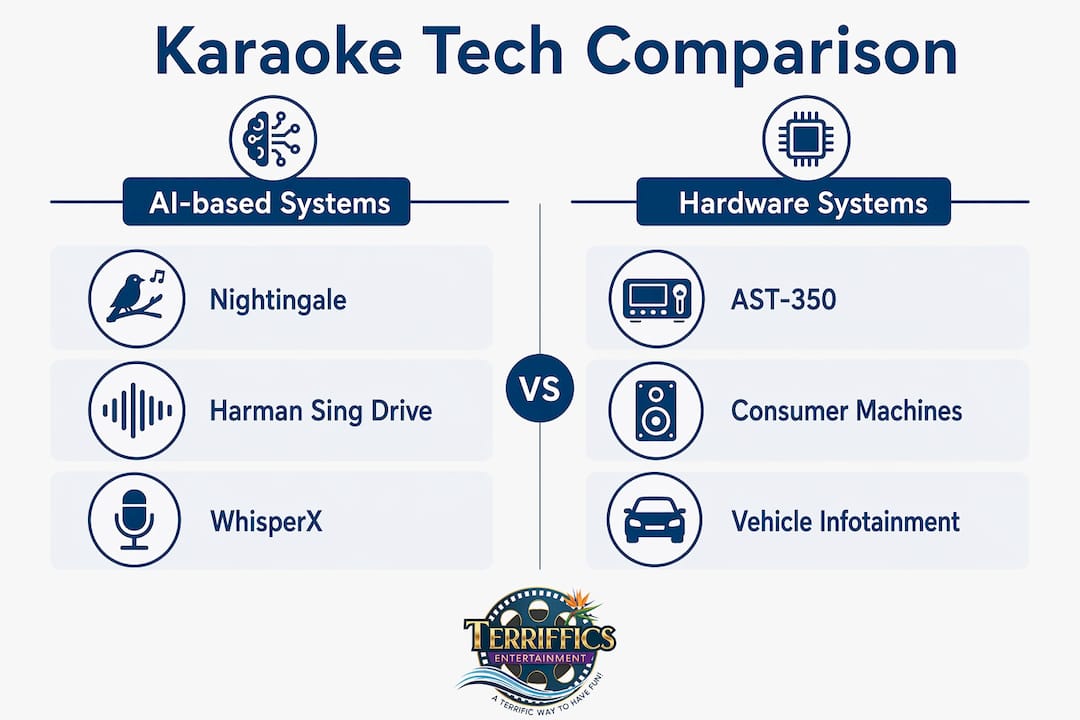
At the other end of the spectrum, Harman’s Sing Drive brings AI vocal removal directly into vehicle infotainment systems. Sing Drive strips vocals from streaming tracks in real time and supports multiple singing modes, turning a car ride into a private karaoke session. It is a genuinely different use case, aimed at commuters and road-trip groups rather than venue operators.
System | Type | Key feature | Best for |
AST-350 | Professional venue system | 32-bit DAC/ADC, low latency, lyric sync | Bars, event venues, KJ hosts |
Harman Sing Drive | In-car infotainment platform | Real-time AI vocal removal from streaming | Commuters, road trips |
Nightingale | Open-source desktop app | Demucs/WhisperX vocal separation, free | Home users, DIY setups |
All-in-one consumer machines | Standalone hardware | Built-in mic, speaker, song library | Casual home use |
The table above shows that no single system dominates every context. A venue operator needs the AST-350’s processing power and reliability. A home enthusiast gets everything they need from Nightingale at zero cost. Harman Sing Drive fills a niche that did not exist in commercial karaoke five years ago.
Pro Tip: When evaluating karaoke hardware for events, prioritize latency specs over raw audio output wattage. A system with lower wattage but sub-10ms latency will always feel better to singers than a louder system with noticeable delay.
Why karaoke is becoming a wellness and social ritual
Karaoke’s growth is not purely a technology story. The social and psychological dimensions are driving bookings in ways that pure entertainment alone cannot explain.
Lucky Voice data shows a 29% increase in zero-alcohol drink sales during karaoke sessions, which signals that people are choosing karaoke as a mindful social activity rather than a drinking occasion. Wellness experts have noted that singing releases endorphins, reduces cortisol, and creates a sense of group cohesion that is hard to replicate through other entertainment formats. These are measurable physiological effects, not marketing claims.
Private karaoke rooms are the design trend most directly tied to this wellness shift. By removing the public performance element, private rooms eliminate the fear factor that keeps less confident singers from participating. Venues report that private room bookings consistently outperform open-stage formats in both frequency and spend per session. The format works because it turns karaoke into a shared ritual among friends rather than a performance for strangers.
Daytime karaoke bookings between 12 PM and 5 PM are also rising, which reflects a 70% year-on-year growth in digital karaoke adoption at UK venues. Daytime slots attract groups who want a social activity without the late-night bar atmosphere. This demographic includes corporate teams, birthday groups, and wellness-focused individuals who would never attend a traditional open-mic karaoke night.
Singing releases endorphins and reduces stress hormones, making karaoke a legitimate wellness activity
Private rooms remove performance anxiety and consistently drive higher booking frequency than open-stage formats
Daytime karaoke is growing as a sober, social alternative to evening bar entertainment
Zero-alcohol drink sales rising alongside karaoke bookings confirms the wellness-driven motivation
For anyone planning a karaoke event for Oahu celebrations, the private room model and daytime timing are worth considering even for outdoor or backyard setups.
What emerging karaoke experiences look like right now
The next wave of karaoke technology advancements moves beyond audio quality and into full sensory and social integration. Here is what is already happening in 2026.
Live streaming and user-generated content. Platforms are partnering with social media networks to let singers stream performances live and share clips directly from the karaoke interface. This turns a private session into shareable content without requiring any post-production work from the user.
Virtual reality karaoke environments. VR headsets now support karaoke apps that place singers inside virtual concert venues, complete with crowd reactions and stage lighting. The experience is designed to simulate the energy of performing live without the social risk of an actual audience.
High-definition spatial audio. Professional sound systems are adopting spatial audio formats that place the singer’s voice and the backing track in distinct acoustic spaces. This makes the mix feel more natural and reduces the “singing over a recording” quality that cheaper systems produce.
Cultural fusion catalogs. The expansion of karaoke demographics is driving demand for multilingual and genre-diverse song libraries. K-pop, Afrobeats, reggaeton, and J-pop now sit alongside classic rock and pop standards in major platform catalogs, reflecting the cultural fusion trend that is pulling younger audiences into the format.
AI-generated harmonies. Some apps now add real-time AI harmonies to the singer’s voice, filling out the sound without requiring a second performer. This feature is particularly popular in solo home sessions where the singer wants a fuller sound.
The entertainment industry trends driving these developments point toward karaoke becoming a multi-platform experience rather than a single-venue activity. The technology is moving fast enough that features considered premium in 2024 are now standard in mid-range consumer apps.
Key takeaways
Karaoke technology in 2026 is defined by AI vocal separation, private room design, and social media integration working together to make the format accessible, wellness-friendly, and shareable for a wider audience than ever before.
Point | Details |
AI replaces licensed catalogs | Tools like Nightingale turn any MP3 into a karaoke track instantly, at no cost. |
Hardware quality gap is narrowing | AST-350 and Harman Sing Drive show professional and consumer tech converging fast. |
Wellness drives bookings | Private rooms and daytime slots attract health-conscious, sober social groups. |
Social media integration is standard | Live streaming and clip sharing are now built into karaoke platforms, not added later. |
Market growth is real | The karaoke market is on track to reach $1.25 billion by 2035, backed by AI and VR adoption. |
Our take on where karaoke tech is actually headed
We have been setting up karaoke for events across Oahu for years, and the honest truth is that the technology gap between a professional setup and a consumer one has shrunk dramatically. What used to require a dedicated KJ with a laptop full of licensed tracks and a mixing board can now be approximated by a well-configured app on a tablet.
That said, the gap that remains is not about hardware specs. It is about experience design. The best karaoke moments we have seen happen when the technology disappears and the people take over. A 32-bit DAC processor matters, but so does having a host who reads the room, a song queue that moves at the right pace, and a sound system that makes every voice sound good regardless of skill level.
What excites us most about event industry trends in 2026 is the wellness angle. Karaoke used to be associated almost exclusively with late-night bar culture. Watching it shift toward daytime, sober, and private-room formats means more of our clients can include it in events where it would not have fit before. Graduations, corporate team days, family reunions. The format is becoming genuinely flexible.
Our advice: do not get distracted by every new feature. Focus on the ones that reduce friction for your guests. AI pitch scoring is fun. Live streaming is exciting. But the feature that actually changes the night is a system that sounds great and never crashes.
— Terriffics
Bring 2026 karaoke technology to your next Oahu event
At Terriffics Entertainment, we bring professional karaoke setups to events across Oahu with fast setup, reliable equipment, and the kind of personal service that makes the night easy for you and unforgettable for your guests. Our karaoke rental Oahu packages are built around the same principles driving the best karaoke experiences in 2026: great audio, smart song management, and a setup that works from the first song to the last. Whether you are planning a birthday, graduation, corporate event, or community gathering, we customize every package to fit your crowd. You can also combine karaoke with our DJ, lighting, and photobooth and DJ packages for a full entertainment setup that covers every part of your event.
FAQ
What is the biggest karaoke technology advancement in 2026?
AI vocal separation is the most significant advancement. Tools like Nightingale use Demucs and WhisperX neural networks to convert any MP3 into a karaoke track instantly, eliminating the need for pre-licensed song catalogs.
How does Harman Sing Drive work?
Harman Sing Drive is an in-car karaoke platform that uses AI to remove vocals from streaming audio in real time, turning any vehicle’s infotainment system into a karaoke setup with multiple singing modes.
Are private karaoke rooms better than open-stage formats?
Private rooms consistently outperform open-stage formats in booking frequency and per-session spend. They remove performance anxiety and attract a wider range of participants, including those who would not sing in public.
What is the karaoke market expected to be worth by 2035?
The global karaoke market is projected to reach $1,247.96 million by 2035, growing at a 3.3% CAGR from 2025, driven by AI integration, VR experiences, and mobile platform adoption.
Can I get professional karaoke quality at home in 2026?
Yes. Open-source tools like Nightingale deliver near-professional vocal separation at no cost. For events requiring venue-grade reliability and audio fidelity, professional systems like the AST-350 remain the standard.
Recommended
Comments