
_edited.png)

Size Outdoor Screens by Farthest Viewer, for Event Planners

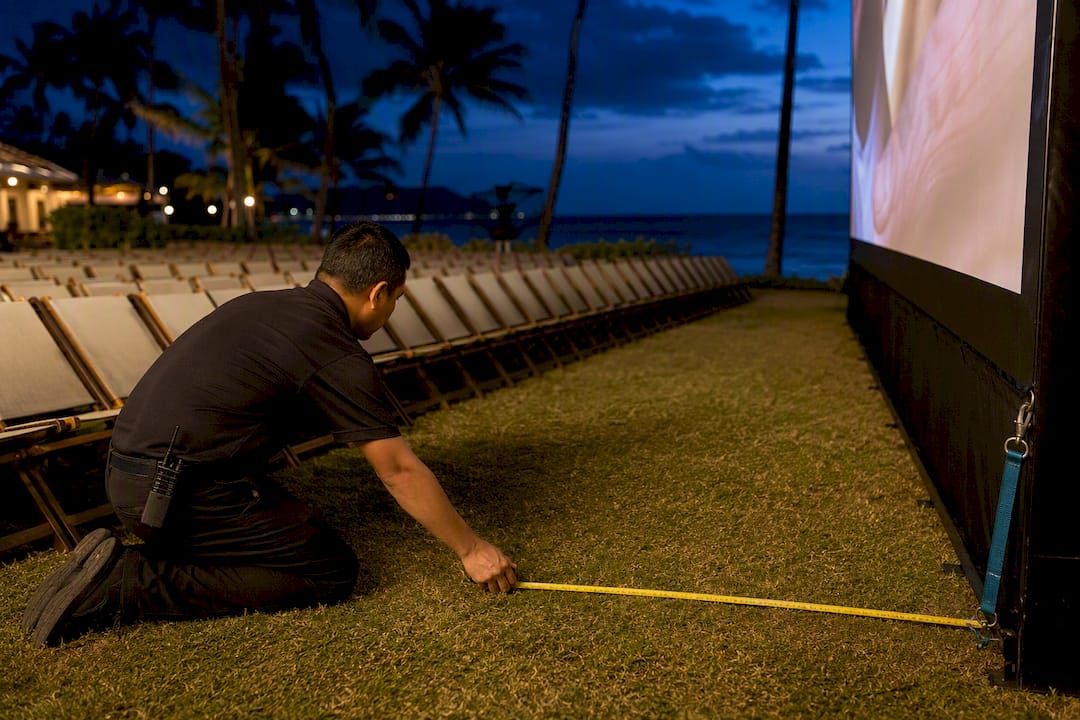
Size your screen to the farthest viewer, not the yard. A good rule of thumb: screen height should be roughly 2 to 4 times closer than your farthest seat, which usually lands you around a 100 to 120 inch screen for a backyard of 15 to 20 people and 20 to 40 feet wide for a park event with 150 to 500 guests. Brightness and wind conditions can change that number fast, so treat this outdoor screen size guide as your starting point, not your final answer.
TL;DR:
Screening should be sized based on your farthest viewer, with a 3x screen height rule for ideal immersion, adjusted between 2x and 4x for comfort.
For outdoor events, projection is suitable at dusk with 2,000 to 3,000 lumens, while LED screens are better for daylight visibility with at least 3,000 nits.
Inflatable screens are quick to set up but poorly suited for windy conditions, whereas fixed installations provide greater stability and image quality with weather-rated materials.
Larger, wide-format screens are preferred for lawns with horizontal seating, as they maintain better sightlines and reduce the need for vertical expansion.
Site conditions like wind, ambient light, and obstacles heavily influence ideal screen size and placement, requiring careful pre-event measurement and testing.
Table of Contents
Recommended Outdoor Screen Sizes by Crowd Size
Matching your screen to your guest list is the fastest way to skip the guesswork. Here’s how sizes typically break down by audience, based on common outdoor screen size recommendations from event planners and rental operators alike.
Backyard (10 to 25 guests): 100 to 150-inch diagonal, or roughly 7 to 11 feet wide. A 16:9 screen works fine here since most home content and streaming apps default to that ratio.
Small public or drive-in style (25 to 100 guests): 12 to 20 feet wide, matching a screen height of about 7 to 11 feet at 16:9. This is the sweet spot for school movie nights and neighborhood block parties.
Medium event (100 to 500 guests): 20 to 40 feet wide. At this scale, attendance and seating layout should drive the decision more than what looked good in a product photo.
Large public event (500+ guests): Extra-large screens commonly used for very large audiences, often constructed with modular LED panels rather than a single fabric sheet.
Go wider than these ranges when your seating spreads horizontally, like a wide lawn or a curved amphitheater. Go taller and deeper into the 2.39:1 cinematic ratio when your rows run long and narrow, since that shape keeps back-row viewers from squinting at a shrunken image. A 150 inch screen sounds massive on paper, but it’s only about 11 feet tall by 19.5 feet wide at 16:9. Always picture the actual footprint before you commit.
How Do You Calculate the Right Viewing Distance?
The most commonly cited rule of thumb comes from the Cinema Technology Association, which recommends seating no farther than about 3 times the screen height for a properly immersive image. Home theater guides tend to widen that window to 2 to 4 times screen height, giving you flexibility for mixed seating like lawn chairs, blankets, and folding rows at different depths.
Here’s the calculation in three steps:
Measure your farthest seat. Walk it off or use a laser measure from the screen location to the last row you expect guests to occupy.
Divide that distance by 3 (using the CTA guideline) to get your target screen height, then adjust between 2 and 4 if your crowd skews toward casual or premium viewing.
Convert height to diagonal using your aspect ratio. For 16:9, diagonal equals height divided by 0.49; for 2.39:1 cinematic content, divide height by about 0.39. This is the same aspect ratio math that governs why a widescreen movie looks letterboxed on a square screen.
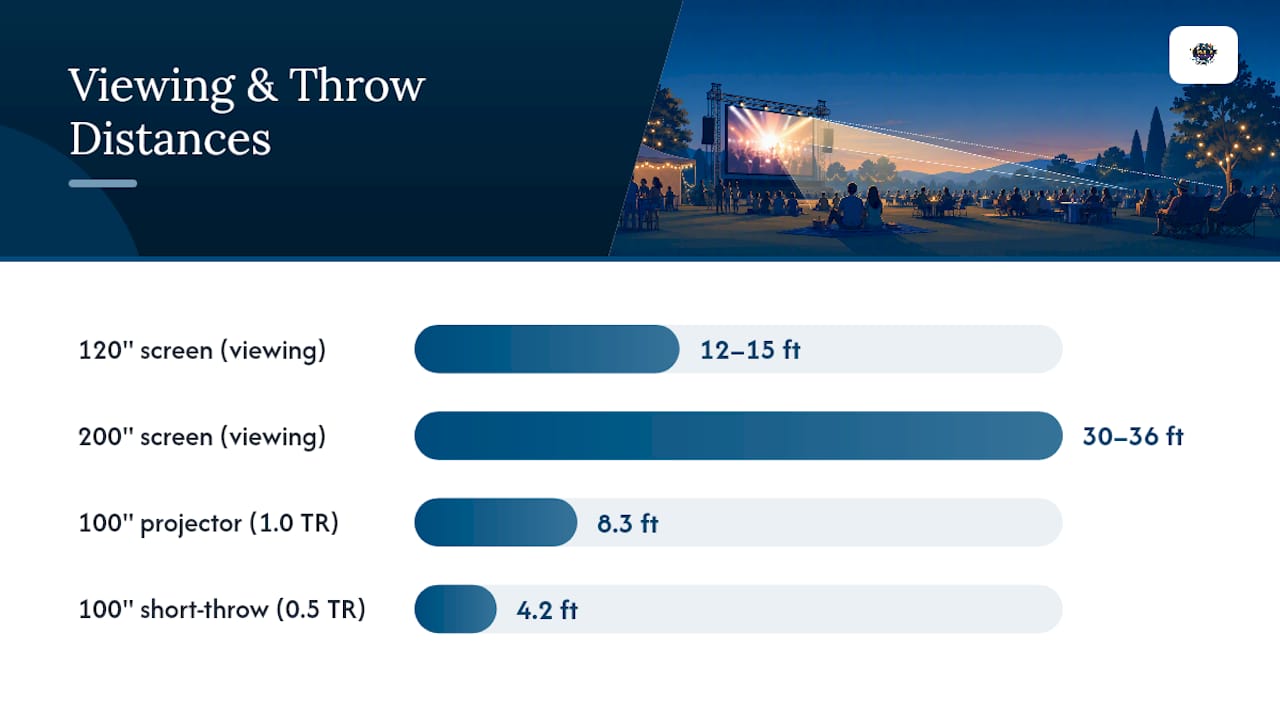
Throw distance follows a similar formula: throw ratio multiplied by screen width equals the distance your projector needs from the screen. A projector with a 1.0 throw ratio needs about 8.3 feet of distance for a 100-inch screen, while a short-throw unit rated at 0.5 only needs about 4.2 feet for that same size.
Pro Tip: For a 120 inch screen, most guides put the ideal seating distance between 12 and 15 feet, but tighten that range if your source content is lower resolution, since pixelation gets obvious up close. For a 200 inch screen at 16:9, that same 3x rule puts your ideal seat around 30 to 36 feet back, which is why big festival setups need serious depth in the seating field, not just width.
Should You Choose Projection or LED for Outdoor Events?
Pick projection for evening and after-dark events on a budget, and pick LED when you need daytime visibility or a screen that survives ambient light without a dedicated dark sky. The two technologies solve different lighting problems, and mixing them up is the single most common mistake first-time event planners make.
Brightness needs scale hard with ambient light:
Projection at dusk: 2,000 to 3,000 ANSI lumens is typically enough once the sky starts to darken.
Projection in full daylight: Requires significantly more lumens than most consumer projectors deliver, which is why daytime outdoor movie screenings are rare without a dedicated high-output unit.
LED at night: Lower nit counts work fine, since there’s little competing light.
LED in mixed lighting (dusk, shade, ambient street light): 3,000 to 5,000 nits is the standard target.
LED in full daylight: 5,000 nits or higher, common for outdoor festival stages and daytime corporate activations.
Pixel pitch matters just as much as brightness for LED walls. The closer your viewers sit, the finer the pitch you need to avoid a visibly dotted image, while large festival crowds standing well back can use a coarser, less expensive pitch without losing image quality. Independent testing labs like RTINGS offer useful benchmarking if you want to verify a specific projector or panel’s real-world output before renting or buying.
One more practical difference: LED panels typically carry weather ratings for continuous outdoor operation, while most projectors and inflatable screens need a dry, low-wind environment and some kind of cover if rain is a possibility.
Which Screen Type Fits Your Setup: Inflatable, Frame, or Fixed?
Outdoor screens generally fall into three builds, and each one trades speed for stability differently. Inflatable screens set up in 10 to 20 minutes but have the lowest wind tolerance of the three, making them a poor fit for open, breezy sites. Frame-mounted portable screens take a bit longer, usually 15 to 30 minutes, and handle moderate wind better thanks to their rigid structure. Fixed, permanent installations require a one-time build but deliver the highest stability and the best image quality over time, since the material stays taut and flat.
Inflatable: Fast, affordable, visually fun for kids’ events, weakest in wind.
Frame-mounted portable: Balanced choice for most rental scenarios, moderate setup time, good stability.
Fixed/permanent: Best for recurring venues like community centers or resorts that host events regularly.
Screen material affects image quality too. Higher-gain fabrics reflect more light back toward the audience, which helps in ambient conditions but narrows the viewing angle, so guests seated far to the side see a dimmer image. Lower-gain, matte white fabric spreads light more evenly across a wider seating arc, a better fit for spread-out lawn seating.
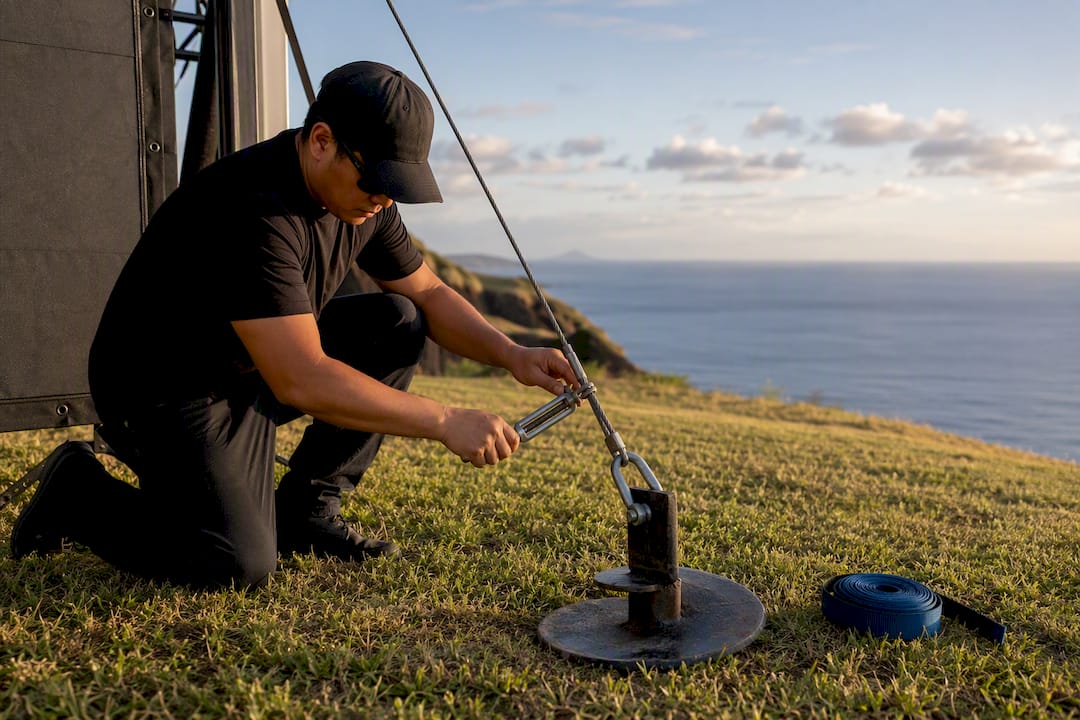
Pro Tip: Skip large inflatable screens entirely on exposed hilltops, waterfront lots, or anywhere gusts regularly exceed 15 to 20 mph. Anchoring and wind rating aren’t optional extras. They’re the difference between a screen and a very expensive kite.
What Site Conditions Change Your Ideal Screen Size?
The perfect calculated size can still fail on site if you skip these checks.
Plan your seating layout first. Rows should rise gradually if the ground allows it, and front-row seating needs a minimum buffer, usually at least the screen height itself, so nobody in the first row gets a stiff neck.
Confirm a clear line of sight from the planned projector position. Trees, fences, and even tall guests standing near the projector can throw shadows across the image.
Route power safely. Use GFCI-protected outlets or generators for any outdoor electrical setup, and keep cables off walking paths.
Check clearance around pools, fences, and public paths. Screens and speaker stands need enough buffer to avoid becoming a tripping or safety hazard once it gets dark.
A little site-planning upfront saves you from discovering, mid-event, that your screen height calculation didn’t account for the giant oak tree blocking half your projector throw.
How Do You Measure and Verify Before You Book?
Run this quick workflow before you finalize a rental or purchase.
Measure your farthest expected seat and note your general seating layout and any fixed mounting points, like a wall, pole, or truss.
Calculate target screen height using the 2 to 4x rule, then derive your width from your chosen aspect ratio.
Verify projector throw distance by multiplying your throw ratio by the screen width, and confirm the projector can physically sit that far back given your site’s layout.
Test onsite before the event. Project a real test image in the evening light you’ll actually be working with, and if you’re using any inflatable screen, do a wind check on setup day.
This same measure-then-verify approach applies whether you’re troubleshooting projector placement for the first time or double-checking a setup you’ve run before.
Quick Checklist Before You Book a Screen
Copy this into any rental request so the provider can match equipment to your event on the first try.
Expected audience size and general age range
Farthest seat distance from the screen
Daytime, dusk, or full nighttime event
Available projector throw distance or panel mounting space
Preferred screen type (inflatable, frame, or fixed)
Site wind exposure and anchoring options
Event type | Starting screen width | Format |
Backyard (10 to 25 guests) | 10 to 15 feet | Inflatable or frame |
Small public (25 to 100 guests) | 12 to 20 feet | Frame-mounted |
Medium event (100 to 500 guests) | 20 to 40 feet | Frame or LED wall |
Large festival (500+ guests) | 40 to 80 feet | Modular LED |
Hire a professional for any public event, complex site, or crowd over 100 people. Beyond that scale, sizing for events involves permitting, power planning, and safety considerations that go past a simple DIY setup.
What Terriffics Has Learned From Real Oahu Setups
We’ve set up outdoor movie nights across Oahu, from tight backyard gatherings to sprawling school fields, and a few lessons repeat every time. Anchoring matters more on windward-facing lots than anywhere else on the island, since trade winds pick up fast after sunset. Audio balance needs a second check once your crowd fills in, because bodies absorb sound differently than an empty field. And for wide, open lawns or drive-in style setups, we consistently size wider than the “textbook” number suggests, since Hawaii’s outdoor gatherings tend to spread out more than mainland backyard parties. If you want more depth on backyard seating layouts, that’s a good next stop.
How Do Climate and Weather Affect Screen Durability?
Oahu’s humidity, salt air, and sun exposure all take a toll on outdoor screen material differently than a mainland backyard setup would. Fabric screens left in direct tropical sun for extended periods can degrade faster, losing gain and developing a yellowish tint over a season or two, so storage between events matters more than owners expect. Salt air near coastal venues accelerates corrosion on metal frame joints and grommets, which is why regular rinsing and drying after beachside events extends a screen’s usable life significantly.
Humidity also affects fabric tensioning. A screen that’s taut and flat in dry conditions can sag slightly in high-humidity air, introducing subtle wrinkles that show up as distortion in a projected image. Frame-mounted screens handle this better than inflatables, since the rigid structure resists sag better than air-supported fabric.
For colder or four-season climates, freeze-thaw cycles on outdoor mounting hardware and UV degradation on PVC-framed inflatables are the bigger long-term concerns. Rotating screens out of direct sun storage, checking seams before each use, and giving fabric a full dry-out after any rain exposure are simple habits that add years to a screen’s life regardless of climate. Fixed installations built with weather-rated, UV-resistant material handle repeated exposure best, which is part of why venues that host events monthly or more often lean toward permanent builds over portable ones.
How Does Ambient Light Change the Ideal Screen Size?
Surrounding light pollution, streetlights, and even a bright moon can shrink your screen’s effective visibility even when its physical dimensions stay the same. A 100-inch screen that looks perfectly sized on a pitch-black rural property can feel washed out and undersized under a nearby stadium light or a well-lit parking lot, because ambient light competes directly with your image for contrast.
The practical fix usually isn’t a smaller or larger screen. It’s more brightness paired with careful screen placement. Position screens away from direct streetlight or building light spill whenever the site allows it, since even modest ambient light can cut perceived contrast dramatically. When you can’t control the surrounding light, lean toward the higher end of the brightness ranges covered earlier, and consider a higher-gain screen material to push more of that available light back toward your seated crowd.
Time of year and moon phase matter more than most planners expect too. A full moon on a clear night adds enough ambient light to noticeably dim a mid-range projector image, while a new moon on an overcast night gives you close to ideal dark-sky conditions. If your event date is fixed, checking the moon phase and any nearby light sources ahead of time helps you decide whether to bump up projector lumens, add a physical light shield, or simply size the screen a bit larger to compensate for lost apparent brightness.
A Field Operator’s Take on Sizing Priorities
If you remember one thing from this guide, make it this: size for your farthest viewer first, then match brightness to whatever ambient light your event actually has, not the ideal dark-sky conditions you’re picturing. Everything else, aspect ratio, screen type, throw distance, is a secondary adjustment once those two decisions are locked in. Forced to choose only two priorities out of everything covered here, brightness and sightlines are the ones that make or break the night. Get those right and a slightly imperfect diagonal size barely matters.
— Terriffics
Ready for a Professionally Sized Outdoor Movie Night?
Terriffics Entertainment is the alternative to guessing your way through screen math on your own. Instead of running formulas and hoping your yard cooperates, tell us your guest count and farthest seating distance, and we handle the throw calculations, brightness matching, and screen selection for you.
Our outdoor movie packages include the projector, screen, and speakers sized to your specific site, whether that’s a backyard birthday for 20 or a school field with 300 families on blankets. To get a quote, just share your expected audience size, event time (day, dusk, or night), and rough distance to your farthest seat. From there, we recommend a screen size and format that fits your space instead of a one-size-fits-all package. Browse our outdoor movie equipment options for a sense of what’s available, or head straight to our rental booking page to check your date and get your event on the calendar.
Sources
FAQ
Is a 120 Inch Screen Big Enough?
Yes, for most backyard and small gathering settings. A 120 inch screen at 16:9 works well for viewers seated 12 to 15 feet back, covering most residential yards and small group events comfortably.
What Are the Typical Sizes of Outdoor Movie Screens?
Sizes scale with audience: backyard events typically use 100 to 150 inch screens, small public gatherings run 12 to 20 feet wide, medium events span 20 to 40 feet, and large festivals often use modular LED walls between 40 and 80 feet wide.
What Are Typical Screen Sizes for Rental Events?
Typical recommended screen sizes are 100 to 150 inch screens for backyard parties, 12 to 20 foot widths for school and community events, and larger modular formats for events exceeding a few hundred guests, adjusting each based on farthest seating distance and site brightness.
Should I Pick a Wider or Taller Screen for Wide Lawn Seating?
Go wider rather than taller when your seating spreads horizontally across an open lawn, since a wider screen keeps side-seated guests within a comfortable viewing angle without forcing everyone into a narrow center section.
Recommended
Comments