
_edited.png)

Role of Event Hosts: What Every Planner Needs to Know


An event host is the person who runs the guest experience and keeps the event flowing on schedule. Their single most important job is protecting that flow — connecting organizers, vendors, and guests in real time so the event feels effortless even when it is not. Think of them as the liaison, the timeline manager, and the room’s energy keeper all rolled into one.
Here is what that looks like in practice:
Greet guests and set a welcoming tone from the first moment
Manage the event timeline and cue transitions between activities
Coordinate vendors and support staff discreetly throughout the event
Handle unexpected issues quickly and without alarming guests
Close the event professionally and collect feedback for the client
Table of Contents
Where does an event host fit in your event team?
The role of event hosts sits squarely between the planning team and the guests. Planners design the blueprint weeks in advance. Vendors execute specific services. The host is the person on the ground who makes all of those pieces work together in real time. They are the face guests see, the voice that guides the room, and the coordinator who keeps vendors on cue.
Most events that hire a dedicated host fall into one of several categories: corporate conferences, weddings, galas, graduation parties, school events, and community festivals. The host is not always the most visible person in the room, but they are usually the most connected. When a speaker runs long, the host quietly signals the AV team and adjusts the timeline. When a guest looks lost, the host redirects them before they interrupt the program.
Working conditions for this role are demanding. Event hosts in the U.S. often work evenings, weekends, and holidays, and the job typically requires standing and walking for extended periods in fast-paced, high-pressure environments. It is not a desk job. Hosts need stamina, composure, and the ability to pivot without showing stress.
The core responsibilities of an event host, by phase
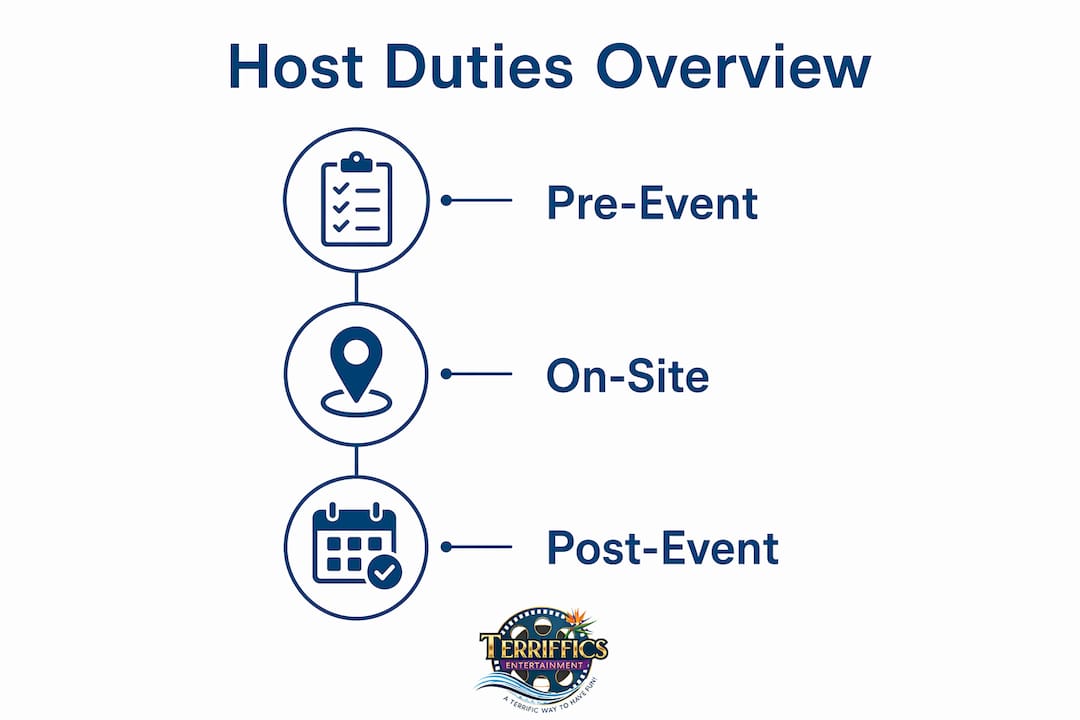
Effective hosting means managing three distinct phases: before the event, during it, and after it wraps. Here is a numbered checklist you can use directly in a job brief or hiring post.
Pre-event
Confirm contracts, vendor arrival windows, and AV cues with all parties
Conduct a site visit to map the venue layout, exits, and key stations
Build or review the run sheet and flag any timing conflicts
Brief all staff and vendors on their roles and communication protocols
Identify VIP guests and confirm any special needs or accessibility requirements
On-site
Arrive early, complete a final walkthrough, and confirm vendor readiness
Welcome guests warmly and direct them to key areas (seating, food, restrooms, exits)
Manage transitions between program segments and cue vendors discreetly
Monitor the timeline and make real-time adjustments when segments run long or short
Handle guest concerns, questions, and minor incidents quickly and quietly
Coordinate with security and safety staff when needed
Post-event
Thank guests and speakers as they depart
Confirm vendor closeout and settle any outstanding logistics
Collect lost-and-found items and document them for the client
Gather feedback from attendees and deliver a brief report to the planner or client
Communication runs through every phase. Hosts should establish a single point of contact for each vendor group before the event and use that contact throughout the day. Clients and planners should receive a brief status update at key milestones: venue ready, doors open, program complete.
Pre-event duties: your timed checklist
The days before an event are where most on-site problems are actually solved. A host who arrives prepared prevents the firefighting that derails timelines.
72 hours out
Confirm all vendor contracts are signed and arrival windows are set
Review the run sheet and flag any gaps or overlaps
Send a written brief to all vendors with their specific cues and contact names
48 hours out
Complete or revisit the site visit; confirm AV setup, power sources, and room layout
Confirm VIP needs: dietary restrictions, accessibility accommodations, seating preferences
Verify emergency protocols with venue management
24 hours out
Distribute the final run sheet to all parties
Confirm photographer, caterer, and entertainment arrival times in writing
Prepare a personal kit: printed run sheet, vendor contact list, backup supplies (tape, markers, phone charger)
Day-of arrival (90 minutes before doors open)
Walk the venue with the venue manager
Conduct a 10-minute vendor huddle to align on cues and signals
Test AV and lighting; confirm the event sound system is ready before guests arrive
Pro Tip: A written run sheet combined with a 10-minute vendor huddle before doors open prevents the majority of day-of miscommunications. Verbal-only briefings leave too much room for interpretation. Put it in writing, then talk through it.
On-site duties: running the event in real time
Once guests arrive, the host’s job shifts from preparation to presence. Effective hosting is not primarily about stage presence or music. It is about quiet, constant communication with the support team so that every transition feels natural.
On-site priorities:
Read the room continuously. Watch energy levels, crowd flow, and body language. If guests are restless during a long speech, be ready to tighten the next segment.
Manage transitions without gaps. Dead air and awkward pauses are the host’s responsibility to fill. Have a 60-to-90-second filler ready at all times (a fun fact, a brief audience prompt, a warm acknowledgment).
Coordinate vendors without disrupting guests. Use discrete vendor signals like hand signals, two-word radio shorthand, or small LED cue lights. A host who shouts across the room to the catering team has already broken the experience.
Protect speakers and VIPs. Keep them on schedule, shield them from unplanned interruptions, and brief them on timing before they go on.
Sample phrases hosts can use:
Welcoming guests: “Welcome, everyone! We’re so glad you’re here. Please find your seats and we’ll get started in just a few minutes.”
Transition to a speaker: “Up next, we have someone who really needs no introduction. Please give a warm welcome to [Name].”
Filling a gap: “While we get set up for the next part of the program, I’d love to hear from a few of you. What’s been your favorite moment so far?”
Correcting a timing issue (discreetly): Walk to the speaker, lean in, and say quietly, “We’re about three minutes over. Wrap up when you can and I’ll take it from there.”
Redirecting crowd flow: “Dinner is being served in the main hall. Head through those doors on your right and the team will show you to your seats.”
For engaging guests throughout the program, the best hosts stay curious and approachable, not performative. They listen as much as they speak.
Post-event duties: closing out professionally
The event ending does not mean the host’s job is done. A clean closeout protects the client relationship and sets up the next event for success.
Immediate tasks (last 30 minutes and after):
Thank speakers, performers, and key guests personally before they leave
Confirm with each vendor that their teardown is complete and any outstanding payments or paperwork are handled
Walk the venue for lost-and-found items; document everything and hand the list to the client or venue manager
Confirm the venue is returned to its agreed-upon condition
Feedback and reporting:
Collect feedback while impressions are fresh. A short verbal check-in with the client right after the event captures the most honest reaction. Follow up within 24 hours with a brief written summary: what went well, what ran long, any vendor issues, and guest comments worth noting. Keep it to one page.
Post-event admin:
Submit any required incident reports the same day. Confirm invoices are accurate before the client receives them. If the event used a registration platform or guest management app, export attendance data and send it to the planner.
Pro Tip: Send the client a one-paragraph written summary within 24 hours of the event. It shows professionalism, gives them something to share with stakeholders, and positions you for rehire before they have even started looking for their next vendor.
How does an event host differ from a planner, emcee, or stage manager?
These four roles often overlap, which creates confusion at the hiring stage. The table below maps each role’s core function, decision authority, and best use case.
Dimension | Event host | Event planner | Emcee / MC | Stage manager |
Primary function | Day-of guest experience and flow | Pre-event design and logistics | Public-facing program narration | Backstage cue and technical control |
When they work | Day of event (plus brief pre-event prep) | Weeks to months before the event | During the program only | During the program only |
Public-facing? | Yes, but often quietly | Rarely on event day | Always | No |
Vendor authority | Coordinates, does not direct | Full authority | None | Cues technical vendors |
Timeline ownership | Day-of timeline | Full event timeline | Program segment timing | Backstage cue sheet |
Best use case | Weddings, galas, corporate events needing a guest liaison | Complex multi-vendor events | Award shows, conferences with speakers | Theater, large productions, multi-stage events |
Understanding the role of event planners versus hosts is the key distinction most hirers miss. Think of it this way: the planner is the architect, and the host is the conductor. Both are necessary at a complex event, but they operate in different time zones. Planners create the blueprint; hosts conduct the live experience. Authority and final on-the-day decisions should be explicitly assigned in the run sheet to avoid any overlap disputes.
When to hire which role:
Host only: Smaller events where logistics are simple and you need someone to manage guest flow and energy.
Planner + host: Weddings, corporate galas, and multi-vendor events where planning complexity is high and day-of execution needs a dedicated person.
Add a stage manager: When the event has a technical backstage component (live performances, multi-screen AV, complex lighting cues).
Add an emcee: When the program requires sustained public narration, audience warm-up, or speaker introductions at scale.
Questions to ask when roles blur: “Who owns the timeline on the day?” “Who has authority to delay a segment?” “Who is the vendor’s single point of contact?” Getting clear answers before the event prevents turf disputes during it.
What skills and qualities should you look for in a host?
Hiring the right host comes down to a short list of measurable skills and a few qualities that only show up under pressure.
Core skills:
Clear verbal communication and active listening
Crowd-reading and energy management
Vendor coordination and basic AV familiarity
Time management and real-time problem solving
Cultural sensitivity and inclusive guest practices
Qualities that separate good hosts from great ones:
Composure under pressure (they stay calm when things go sideways)
Genuine warmth (guests feel welcomed, not managed)
Discretion (they fix problems without making guests aware there was one)
Initiative (they do not wait to be told when something needs attention)
Optional credentials worth noting:
Food safety awareness certification (relevant for events with catering)
Crowd management or emergency response training
CPR and first aid certification for large-scale events
Sample interview questions:
“Tell me about a time a key element of an event failed. What did you do in the first two minutes?”
“How do you signal a vendor to hold without making an announcement to the room?”
“A guest approaches you upset about their seating. The event is starting in five minutes. Walk me through your response.”
“How do you adjust your energy and pacing when you can tell the room is disengaged?”
“Describe how you handle a speaker who goes significantly over time.”
Pro Tip: When interviewing hosts, ask at least one question about cultural sensitivity. A host who acknowledges accessibility needs, pronounces guest names correctly, and creates space for diverse behaviors avoids the kind of exclusionary moments that damage an event’s reputation. This is not a soft skill. It is a professional requirement.
Copy/paste hiring assets: job description, day-of brief, and shift schedule
Sample event host job description
Position: Event Host Employment type: Part-time / contract / per-event Reports to: Event planner or event manager
Responsibilities:
Greet and direct guests throughout the event
Manage the day-of timeline and cue transitions between program segments
Coordinate with vendors, catering, AV, and security staff
Handle guest questions, concerns, and minor incidents discreetly
Conduct pre-event venue walkthrough and vendor briefing
Collect and document post-event feedback for the client
Requirements:
High school diploma or equivalent; hospitality experience preferred
Strong communication and interpersonal skills
Ability to stand and walk for extended periods
Availability for evenings, weekends, and holidays
Composure in fast-paced, high-pressure environments
Working conditions: Events typically run 4–10 hours. Setup and teardown time may extend the shift.
Day-of brief template
Item | Details |
Event name and date | [Event name] — [Date, start time, end time] |
Venue address and parking | [Full address] — [Parking instructions] |
Host arrival time | [Time] (90 minutes before doors open) |
Run sheet location | [Printed copy in host kit / shared drive link] |
Vendor contacts | [Name, role, phone for each vendor] |
VIP notes | [Names, needs, seating, dietary restrictions] |
Emergency protocol | [Venue emergency contact, nearest exit plan, first aid location] |
Client contact on the day | [Name, phone, preferred communication method] |
Post-event report due | Within 24 hours of event close |
Sample shift schedule
Time | Task |
T-90 min | Arrive, venue walkthrough with manager |
T-60 min | Vendor huddle, confirm cues and signals |
T-30 min | Final AV and lighting check |
T-15 min | Host station ready, welcome materials in place |
Doors open | Guest greeting begins |
Program start | Timeline management and transitions |
Mid-event check | Confirm catering timing, speaker readiness |
Program close | Thank-yous, guest departure, lost-and-found sweep |
Post-event | Vendor closeout, client debrief, feedback collection |
Common on-the-day challenges and how to handle them
Even a perfectly planned event hits snags. Here is how experienced hosts handle the most common ones.
Scenario 1: Speaker or performer delay
Immediately deploy a filler moment (audience Q&A, a fun poll, a brief acknowledgment of sponsors)
Notify the client or planner quietly; do not announce the delay to the room
Script: “While we get our next guest ready, I’d love to take a quick moment to recognize a few people who made tonight possible…”
Scenario 2: AV or technical failure
Signal the AV team using your pre-agreed cue (radio shorthand or hand signal)
Keep guests engaged with light conversation or a brief activity
If the fix takes more than two minutes, acknowledge it lightly: “We’re having a quick technical moment. Bear with us — we’ll be back up in just a second.”
Escalation: if the issue is not resolved in five minutes, notify the venue manager and the client
Scenario 3: Late guest arrivals disrupting the program
Station a staff member at the entrance to guide latecomers to seats quietly
Do not pause the program for individual arrivals
If a large group arrives late and disrupts flow, pause briefly: “Welcome, everyone just joining us. Please find a seat and we’ll pick right back up.”
Scenario 4: Guest conflict or complaint
Move the conversation away from the main event space immediately
Listen fully before responding; do not argue or dismiss
Resolve what you can on the spot; escalate to security only if safety is a concern
Scenario 5: Program running significantly over time
Identify which upcoming segments can be shortened without damaging the guest experience
Brief the next speaker privately: “We’re running about 10 minutes behind. Can you tighten to [X] minutes?”
Never cut a segment without notifying the client first
Troubleshooting quick rule: When in doubt, improvise to buy time, then escalate quietly. Guests rarely notice a two-minute gap if the host fills it with warmth and confidence.
Why professional hosts make a real difference
Hosting blends art and science: logistical coordination on one side, interpersonal judgment on the other. The best hosts manage both without making either look effortful.
Consider a wedding reception where the caterer signals they need an extra 12 minutes before dinner service. An unprepared host announces the delay and watches the room energy drop. A professional host quietly extends the cocktail hour, cues the DJ to keep the floor warm, and moves the couple into a private moment with their photographer. Guests never know anything shifted.
That kind of invisible leadership is what a professional host delivers: clients and couples get to be fully present at their own event because someone else is carrying the logistics.
Pro Tip: Stay intentionally invisible. Your job is to make the event look effortless, not to make yourself memorable. If guests are talking about the host at the end of the night, something went wrong.
Key Takeaways
A great event host protects the guest experience by managing flow, vendors, and contingencies across all three phases: pre-event, on-site, and post-event.
Point | Details |
Hire for judgment, not just charisma | The best hosts stay calm under pressure and solve problems before guests notice them. |
Brief thoroughly before every event | A written run sheet plus a 10-minute vendor huddle prevents most day-of miscommunications. |
Clarify role authority upfront | Assign timeline ownership and vendor contact authority in writing before the event day. |
Plan contingencies for common failures | Prepare fillers, escalation contacts, and scripts for AV failure, delays, and late arrivals. |
Terrifficsentertainment pairs entertainment with hosting | For Oahu events, Terrifficsentertainment provides DJ, photobooth, and karaoke services that work alongside a dedicated host setup. |
What every new host should hear once
The biggest mistake new hosts make is treating the role like a performance. It is not. The event is the performance. You are the stage manager who happens to be visible.
The one tip worth carrying into every event: write your run sheet as if you will not be there to explain it. If every vendor, every staff member, and every backup contact can execute from your written brief without calling you, you have done the pre-event work correctly. That document is your safety net and your credibility in one page.
Planning an event on Oahu? Terrifficsentertainment has you covered
Hiring a skilled host is one piece of the puzzle. The entertainment that surrounds them is the other. Terrifficsentertainment brings professional DJ sound and lighting, an AI-powered photobooth rental, karaoke, and outdoor movie setups to weddings, graduations, corporate events, and community gatherings across all of Oahu. Our packages are flexible, our setup is fast, and our team coordinates directly with your host or planner so nothing falls through the cracks.
We do not replace a host or a full-service planner. We supply the entertainment layer that makes a host’s job easier and your guests’ experience unforgettable. When your host cues the music, we are ready.
Ready to lock in entertainment for your next event? Get a quote or browse our past events to see what we bring to Oahu celebrations.
Useful sources and further reading
Understanding the Key Responsibilities of an Event Host — DJ Mike Farmer: A thorough breakdown of host duties including cultural sensitivity, guest management, and on-site coordination. Useful for hirers building a job brief.
What Does an Event Host Do? — The Sixpence: Practical overview of day-of priorities, run sheet structure, and the host’s relationship to planners and vendors.
Event Host Job Description — InterviewGuy: Covers core responsibilities, sample job description language, and the ROI of hiring a professional host for high-stakes events.
Event Host Job Description — Betterteam: Clean, copy-ready job description template with working conditions, requirements, and a responsibilities checklist.
The Responsibilities of a Professional Event Host — Class in a Coat: Practitioner perspective on the art-and-science balance of hosting, including proactive troubleshooting and composure under pressure.
What an Event Host Really Does During a Celebration — Rob Alberti: Corrects common misconceptions about hosting and explains discrete vendor coordination techniques used by experienced professionals.
12 Primary Responsibilities of Event Hosts — Indeed UK: Comprehensive list of host responsibilities across all event phases; useful for training checklists and performance reviews.
Terrifficsentertainment — Event Entertainment on Oahu: Oahu-based entertainment provider offering DJ, photobooth, karaoke, and outdoor movie services for events of all sizes; a practical vendor option for planners building an entertainment-plus-host setup.
Recommended
Comments