
_edited.png)

Role of Event Support Staff: What Renters Need to Know

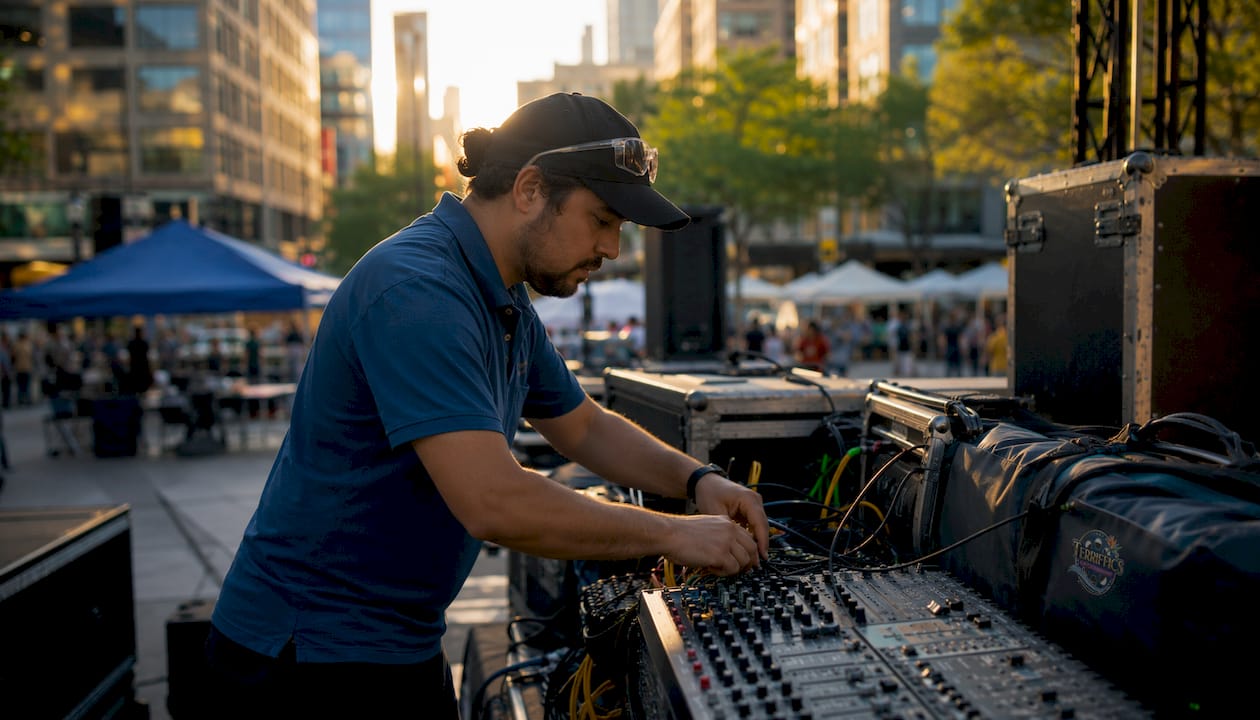
Event support staff handle setup, live technical and guest management, and teardown. If you’re renting entertainment equipment, you almost always need at least one technician for events over 50 guests — and dedicated support becomes critical past 100, where on-site support shifts from helpful to essential.
Here’s what support staff actually cover:
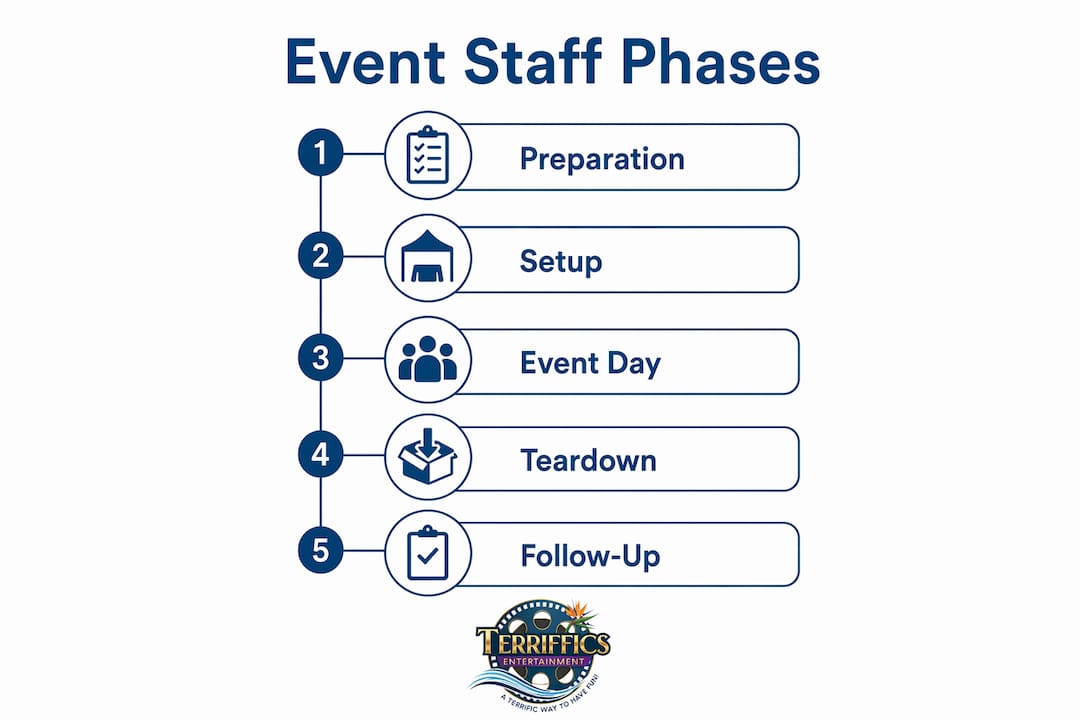
Pre-event: Equipment installation, rigging, sound and lighting setup, seating arrangement
Live event: Guest greeting, technical monitoring, crowd flow, troubleshooting
Post-event: Equipment inventory, teardown, site cleanup, damage reporting
Our recommendation for renters: For smaller events with simple gear, you can often self-manage. As guest count and complexity increase, adding technicians and managers is recommended to maintain smooth operations. Cvent’s guidance confirms that events over 100 attendees reach a complexity threshold where dedicated staff prevent small issues from cascading. Envisage Promotions adds that the highest-value staff are flexible and resolve problems before attendees ever notice. Terrifficsentertainment bundles technical setup staff with DJ, photobooth, karaoke, and outdoor movie packages across Oahu.
Pro Tip: Ask your rental provider whether equipment compatibility testing is included before the event day. On-site testing catches audio conflicts, power issues, and projection problems that only show up once everything is connected.
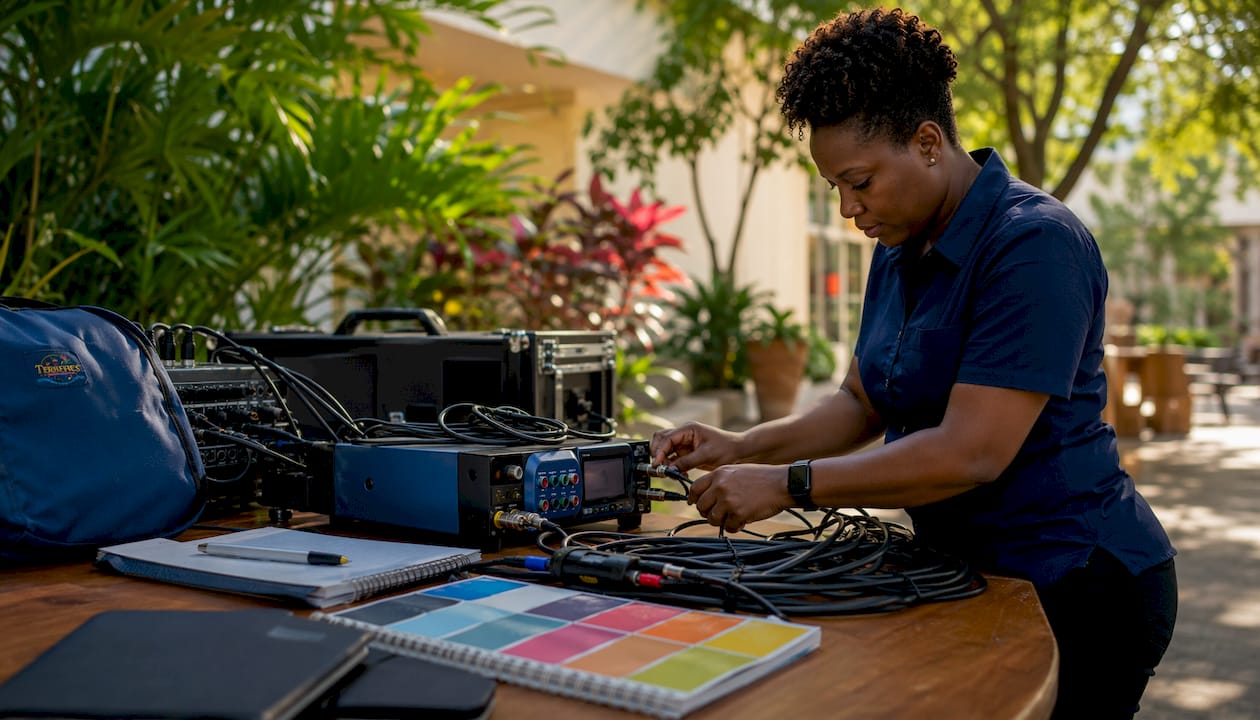
Table of Contents
What do event support staff do across the three phases?
Support staff responsibilities divide cleanly into three phases, and knowing each one helps you decide exactly what to include in your rental package.
Pre-event preparation
Site survey and venue walkthrough
Sound system and lighting installation and cable management
Projection screen and outdoor movie equipment setup
Equipment power testing and compatibility checks
Seating and staging arrangement
Live event management
Guest greeting and check-in
Technical monitoring (audio levels, lighting cues, projection)
Crowd flow and floor management
Real-time troubleshooting without disrupting attendees
Post-event breakdown
Full equipment inventory against the rental manifest
Teardown, packing, and labeling
Site cleaning and final venue sign-off
Damage reporting and documentation
For complex builds involving suspended lighting or large projection screens, industry guidance recommends booking staff and scheduling site visits 3–6 months in advance. For a standard backyard movie night or birthday DJ setup, two to four weeks is usually enough. Setup typically runs 1–3 hours before doors open; teardown adds another 1–2 hours after the event ends.
Pro Tip: Verify with your rental provider that on-site equipment testing is part of the agreement, not an add-on. Pre-event technical testing is what separates a functioning setup from a flawless one.
Which staff roles actually matter for entertainment rentals?
Defining roles by function produces more predictable outcomes than assigning generic “extra hands.” Here’s a practical map of the roles relevant to DJ, photobooth, karaoke, and outdoor movie rentals.
AV Technician
Installs and operates sound systems, mixers, and speakers
Monitors audio levels throughout the event
Needed for: Any amplified sound or projection setup
Lighting Technician
Rigs and programs lighting fixtures, uplighting, and effects
Adjusts cues live during the event
Needed for: Events with uplighting, moving heads, or stage wash
Floor Manager / Event Captain
Single point of contact between the host, staff, and vendors
Manages the run-of-show timeline and handles escalations
Needed for: Any event over 75 guests or with multiple entertainment zones
Hosts / Greeters
Welcome guests, manage check-in lines, answer questions
Keep foot traffic moving and direct guests to activities
Needed for: Events over 150 guests or multi-entry venues
Riggers / Load-In Crew
Handle suspended lighting, truss systems, and large screens
Needed for: Overhead rigging, large outdoor screens, or heavy equipment
Security / Crowd Control
Monitor capacity limits and enforce venue rules
Needed for: Public events, alcohol-licensed venues, or events over 200 guests
Key qualifications to look for: AV technicians with hands-on sound system experience, floor managers with crowd-management training, and all staff familiar with local venue rules and event technology requirements.
How many staff do you need for your event size?
A simple rule of thumb: under 50 guests, one technician often covers everything. From there, staffing scales with headcount and complexity.
Event Type | Guest Count | Suggested Staff |
Backyard movie night | Under 50 | 1 AV tech |
Birthday / graduation party | 50–100 | 1–2 techs, 1 floor manager |
Wedding reception | 100–200 | AV lead, 2 techs, 2 hosts |
Corporate reception | 150–300 | AV lead, 2–4 techs, 2–3 hosts, 1 floor manager |
Outdoor festival / activation | 300+ | Full crew: AV lead, 4+ techs, hosts, security |
Three quick scenarios:
Backyard outdoor movie night (30 guests): One technician handles projector setup, speaker placement, and screen assembly. Total staff time: roughly 2 hours setup, 3 hours coverage, 1 hour teardown.
150-person wedding reception: An AV lead manages DJ sound and lighting; two technicians handle the photobooth and karaoke station; two hosts manage guest flow and check-in. Staff arrive 2–3 hours before guests.
300-person corporate reception: A floor manager coordinates the full run-of-show; an AV lead and three technicians cover multi-zone audio and lighting; three hosts manage registration and crowd flow. Plan for a 4-hour setup window.
Most technicians work on a 4-hour minimum. Factor in arrival, setup, full event coverage, and teardown when calculating total labor hours.
What does support staff pricing look like?
Pricing for event support staff typically follows one of three models: hourly rates, flat setup/teardown fees, or bundled packages that include both equipment and labor.
Common pricing components to expect:
Hourly labor rates for technicians (varies by market and role complexity)
Flat setup fees covering installation and pre-event testing
Travel or island surcharges for remote venues or off-grid locations
Overtime rates when events run past the contracted end time
Minimum charge windows (commonly 4 hours for technicians)
Post-event labor for inventory, teardown, and damage documentation
Bundled rental packages that include technical setup staff tend to reduce total cost compared to renting gear and hiring labor separately, because compatibility testing and logistics are handled together.
Before signing any quote, verify these terms:
Exact staff arrival time and scope of pre-event tasks
Whether equipment compatibility testing is included
Liability and insurance coverage for equipment and staff
Cancellation policy and overtime rate structure
Minimum hours and what happens if the event runs short
Should you hire support staff or self-manage your rental?
Start here: if your event is under 50 guests, the gear is simple, and you’re comfortable running a soundboard, self-managing is reasonable. In most other cases, adding at least one technician pays for itself in stress reduction alone. Convention Staffing Group notes that planners who manage both equipment and guests experience event fatigue — dedicated support preserves your ability to actually enjoy your own event.
Hire support staff if you answer yes to any of these:
Guest count exceeds 100
Setup involves suspended rigging, multi-zone audio, or livestreaming
You’ll be hosting and running the show simultaneously
The venue has union rules or specific insurance requirements
You have no backup plan if a technical issue arises mid-event
Self-manage if all of these are true:
Under 50 guests
Single-zone audio with plug-and-play gear
You have a trusted helper on-site
No rigging, projection, or multi-system integration
Questions to include in any vendor request:
“Do you include on-site cable management and spare parts?”
“What are your minimums and overtime rates?”
“Will a technician stay through teardown?”
“What’s your protocol if equipment fails during the event?”
Red flags to watch for: vague scope of work, no proof of insurance, no written run-of-show participation, and unwillingness to test equipment on-site before guests arrive.
What actually happens on event day?
A typical run-of-show for support staff looks like this:
Staff arrival (2–3 hours before doors open): equipment unloading, venue walkthrough
Setup and installation (1–3 hours): rigging, cabling, system configuration
Soundcheck and technical test (30–60 minutes before guests arrive): full system run, lighting cues, projection test
Pre-event walk (15 minutes before doors): floor manager confirms all stations are ready
Live coverage (full event duration): technical monitoring, guest support, crowd flow
Teardown and inventory (immediately after event): pack-out, damage check, venue sign-off
Communication protocols that matter:
One floor manager serves as the single point of contact for the host, venue, and all staff
Radio or group-text check-ins at key milestones (doors open, halfway through, last call)
Emergency contacts confirmed before the event starts, not during
Post-event, staff complete a full equipment inventory, document any damage, pack and label all gear, and get a final sign-off from the venue. Cvent’s guidance on on-site event support notes that staff are also responsible for enforcing venue capacity limits and safety protocols throughout the event. A solid event schedule workflow built before the day makes all of this run far more smoothly.
Key Takeaways
Event support staff are the difference between a rental that works and an event that runs flawlessly — and the right staffing level depends entirely on your guest count, gear complexity, and how much you want to focus on your guests.
Point | Details |
100-guest threshold | Past 100 attendees, dedicated support staff shift from optional to critical for crowd flow and technical reliability. |
Three core phases | Staff cover pre-event setup, live technical and guest management, and post-event teardown and inventory. |
Role specialization | Assigning specific roles (AV tech, floor manager, hosts) produces more predictable outcomes than using generic helpers. |
Pricing verification | Always confirm minimums, overtime rates, and whether compatibility testing is included before signing a quote. |
Terrifficsentertainment | Bundles technical setup staff with DJ, photobooth, karaoke, and outdoor movie packages across Oahu for a single, coordinated booking. |
The part most renters overlook
Here’s something we see often: a customer rents a solid DJ and lighting package, handles the setup themselves, and then spends the first hour of their own event troubleshooting a ground loop hum or a projector that won’t sync. The gear was fine. The missing piece was someone who had set up that exact system before, in a venue like that one.
On Oahu, outdoor events add a layer of complexity that’s easy to underestimate. Wind, humidity, uneven ground, and varying power supplies at parks and beach venues all affect how equipment performs. When we set up an outdoor movie night, for example, our technician arrives early specifically to assess those conditions and adjust placement before a single guest walks in. That’s not extra service. That’s what makes the difference between a movie night and a memorable one.
The role of event planners is to create the vision. The role of support staff is to protect it on the day. When those two things are aligned, events feel effortless to guests — because all the work happened before they arrived.
Ready to book entertainment with setup included?
Terrifficsentertainment makes it easy to get the gear and the people to run it, all in one booking. Whether you’re planning a wedding, graduation, school event, or corporate gathering on Oahu, we bring DJ sound and lighting, an AI-powered photobooth, karaoke, and outdoor movie setups with fast, professional installation handled by our own team.
When you reach out, include your event date, venue, expected attendance, and any specific gear you’re considering. That gives us everything we need to put together the right package and confirm staff availability for your date. Browse our past setups and equipment to get a feel for what’s possible, then contact us to get a custom quote. No guesswork, no surprises on the day.
Sources and further reading
What do event staff do? — LiveForce: Detailed breakdown of support staff duties across all three operational phases.
How On-Site Event Support Impacts the In-Person Experience — Cvent: Industry guidance on complexity thresholds and why dedicated staff matter past 100 guests.
A Practical Guide to Successful Event Support — Envisage Promotions: Emphasis on staff flexibility and behind-the-scenes detail as the highest-value traits.
Event staff roles explained — EventStaff: Role-based staffing framework for predictable event execution.
On-site event support: complete guide — Motlow Pro Media: Lead-time guidance and the value of pre-event technical testing.
What Is Event Support and Why Is It Important? — Convention Staffing Group: Covers event fatigue and why dedicated teams protect the host experience.
What Is a Professional Event Team? — Terrifficsentertainment: Deeper look at event team roles and benefits for hosts.
DJ Event Checklist: Your Complete 2026 Planning Guide — Terrifficsentertainment: Practical setup and teardown timing guidance for DJ events.
Role of Event Hosts — Terrifficsentertainment: Front-of-house duties and how hosts shape the attendee experience.
For site-specific advice on staffing your Oahu event, contact Terrifficsentertainment directly. We’re happy to walk through your run-of-show and recommend the right package.
Recommended
Comments