
_edited.png)

School Event Entertainment Options: A 2026 Planning Guide

School event entertainment options are defined as the organized activities, performances, and interactive experiences that engage students during school functions such as dances, field days, assemblies, and graduation celebrations. Choosing the right mix matters because entertainment shapes student participation, builds community, and determines whether an event feels worth attending. The best programs balance variety, age-appropriateness, and practical logistics. This guide covers the top options for 2026, with planning frameworks built for parents and school event organizers across every budget and event size.
1. What are the best school event entertainment options?
The strongest school event entertainment options share three qualities: they scale to your crowd size, they suit your students’ age group, and they fit within your venue’s physical limits. Organizers who treat entertainment as a single main attraction usually end up with long lines and restless students. A multi-station approach solves that problem directly.
Event flow matters more than any single activity. Rotating stations keep energy consistent and prevent bottlenecks, especially for groups over 200 students. The sections below break down each entertainment category in detail so you can build the right combination for your event.
2. Interactive games and activity stations
Interactive games are the backbone of most successful school events. Carnival games, relay races, field day classics, and team challenges all work because they require participation rather than passive watching. Students stay engaged when they have something to do with their hands and their competitive instincts.
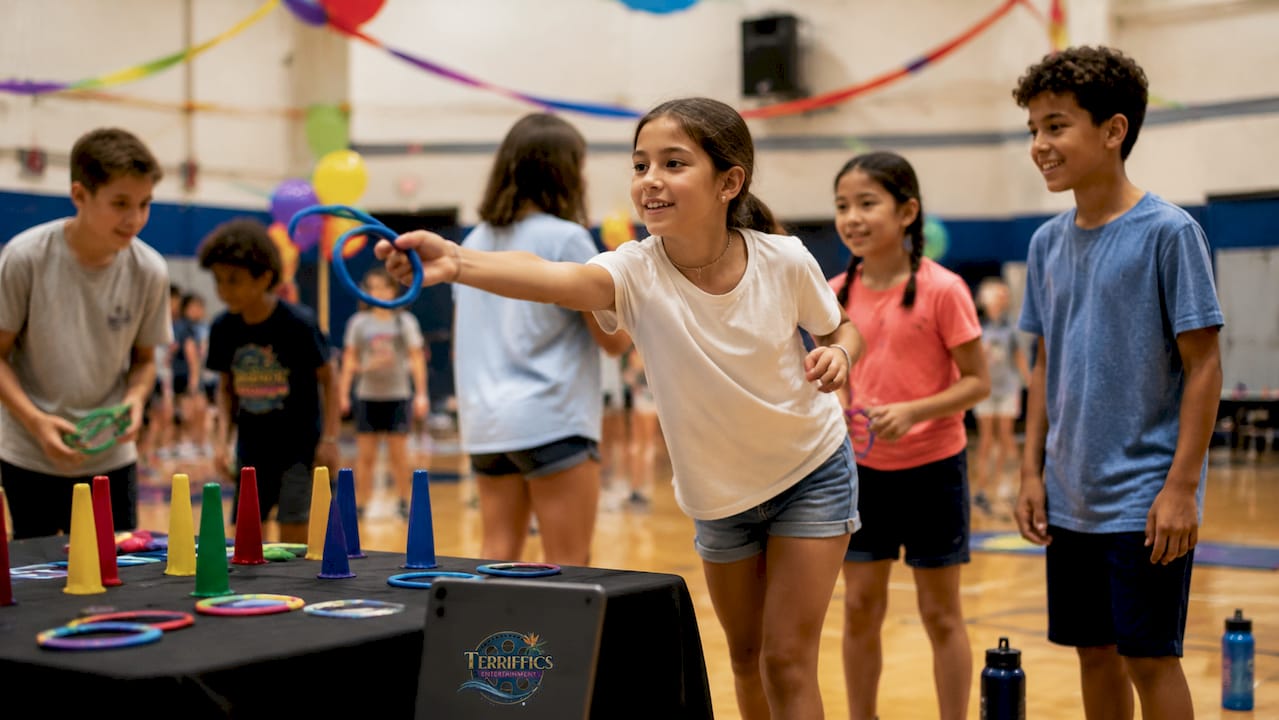
Rotating stations are the most effective format for managing large groups. For half-day events, 5–7 stations keep students moving without crowding. Full-day events can support 8–12 stations comfortably. That structure also gives organizers natural checkpoints to monitor energy levels and adjust pacing.
Popular station formats include:
Carnival games: Ring toss, duck pond, and ball toss work for elementary through middle school.
Relay races and field day classics: Sack races, tug-of-war, and obstacle courses suit outdoor venues and large groups.
Team challenge stations: Trivia challenges, scavenger hunts, and build-it competitions work well for high school events.
Inflatable attractions: Bounce houses and obstacle inflatables add visual excitement and draw students in quickly.
Skill-based games: Archery tag and ladder toss appeal to older students who want a real challenge.
Pro Tip: Customize game names and themes to match your school mascot or event theme. A relay race becomes a “Warrior Sprint” or a “Dolphin Dash” with one small change, and that personalization makes students feel the event was built for them.
Professional packages that include setup, staffing, and teardown remove the biggest logistical burden from school organizers. Structured activity programs that include trained staff also reduce supervision pressure on teachers.
3. Photo booths and immersive visual entertainment
Photo booths are one of the highest-participation entertainment formats at school events. Students use them repeatedly, they generate shareable content, and they create physical keepsakes that last beyond the event itself. An AI-powered photo booth adds digital filters, instant prints, and branded overlays that make every photo feel custom.
Setup requirements are straightforward. Most photo booth setups need a 10x10-foot footprint, a standard power outlet, and adequate lighting. Green screen options expand the creative range significantly, letting students choose themed backgrounds for prom, spirit nights, or graduation celebrations.
Key photo booth formats for school events include:
Open-air booths: Fit more people per shot and work well for large groups.
Green screen setups: Let students pick custom backgrounds tied to the event theme.
360-degree video booths: Capture slow-motion video clips that students can share digitally.
Selfie stations: Lower-cost, self-serve options that work as secondary attractions.
Video walls and interactive visual displays add another layer of engagement for larger events. A live social media feed displayed on a video wall encourages students to participate and see their content featured in real time.
Pro Tip: Tie your photo booth backdrop directly to the event theme and pre-load 3–4 prop options that match. A generic booth with random props gets used once. A themed booth with school colors and mascot props gets used all night.
Entertainment for school events that includes a visual component consistently drives higher overall participation because students who might skip a game will still stop for a photo.
4. Live music and professional DJ services
A professional DJ is the single most effective tool for energizing a school dance, pep rally, or graduation celebration. The DJ controls the room’s energy through music selection, pacing, and crowd interaction. That level of control is impossible to replicate with a playlist.
Clean, current music aligned with school policies is non-negotiable. Professional school event DJs maintain edited music libraries and understand how to read a student crowd without relying on explicit content. That distinction separates a professional from a friend with a speaker.
Enhanced DJ setups for school events typically include:
DJ sound system: Scaled to venue size, from gymnasium to outdoor amphitheater.
LED lighting and effects: Dance lighting, uplighting, and moving heads transform a plain gym into an event space.
Silent disco headphones: Let students choose their music channel, which works well for events with mixed age groups or noise restrictions.
Karaoke integration: Adds a participation layer that gets students on stage and keeps energy high between DJ sets.
Aligning entertainment to campus policies and student expectations produces better outcomes than trying to be edgy. Professional, structured formats resonate better in middle and high school settings than entertainment that tries too hard to feel spontaneous.
Pro Tip: Confirm power requirements and venue layout with your DJ at least two weeks before the event. Most professional setups need dedicated circuits, and discovering that on setup day causes delays that eat into your event time.
The school dance DJ process works best when the DJ receives a do-not-play list, a must-play list, and a clear timeline before the event starts.
5. Specialty entertainment options for unique school events
Specialty attractions give school events a memorable identity that standard games and music cannot. Laser tag, dunk tanks, therapy animal visits, and archery tag each serve a specific purpose beyond entertainment. They create talking points that students carry into the following week.
Effective entertainment reduces stress and builds community by encouraging inclusive participation across abilities. Therapy animal visits, for example, work particularly well for end-of-semester stress relief events and special education inclusion programs. Archery tag and laser tag appeal to students who disengage from traditional carnival formats.
Specialty options worth considering include:
Laser tag: Portable setups work in gymnasiums and outdoor spaces. Scales well for groups of 20–100 students per session.
Dunk tanks: Classic crowd-pleaser when teachers or administrators volunteer. Creates a shared experience between students and staff.
Archery tag: Safe foam-tipped arrows make this accessible and exciting for middle and high school groups.
Therapy animal visits: Certified handlers bring calm, interactive experiences that support student wellness goals.
Outdoor movie nights: A projector, screen, and sound system turn any open space into a community gathering.
Professional school event entertainment packages range from $2,280 to over $10,995 for four-hour events, typically including setup and staff. That range reflects the difference between a single-attraction setup and a full multi-station event with specialty features.
6. How to choose the right combination of entertainment
Choosing the right entertainment mix starts with three fixed variables: your student count, your venue type, and your event duration. Every other decision flows from those three facts.
Scalability and rotating stations for groups over 200 students prevent long lines and keep energy consistent. For smaller events under 100 students, a single main-stage format with one or two supporting activities works better than spreading resources across too many stations.
Entertainment category | Best for | Indoor or outdoor | Scales to large groups |
Interactive game stations | Field days, carnivals | Both | Yes |
Photo booths | Dances, proms, graduations | Indoor | Moderate |
DJ and live music | Dances, rallies, assemblies | Both | Yes |
Specialty attractions | Unique events, wellness days | Both | Varies |
Outdoor movie nights | Community events, end-of-year | Outdoor | Yes |
Budget planning requires accounting for auxiliary costs beyond the base package. Power sources and sufficient space are the two most common logistical gaps. Outdoor events often need a generator, and that cost adds to the total. Indoor venues need a power load assessment before booking any entertainment that uses amplified sound or lighting.
Pro Tip: Build your entertainment plan around your slowest 20 minutes, not your busiest. If you have a gap between the DJ set and the photo booth opening, students disengage fast. Map the full event timeline before you finalize any vendor.
Flexible entertainment packages that let you mix and match services give you the most control over both budget and event flow.
Key takeaways
The most effective school event entertainment combines rotating activity stations, age-appropriate programming, and professional logistics support to keep every student engaged from start to finish.
Point | Details |
Station count drives flow | Use 5–7 stations for half-day events and 8–12 for full-day events to prevent crowding. |
Age-appropriateness is non-negotiable | Curriculum-aligned, age-appropriate entertainment improves engagement and avoids alienating students. |
Logistics determine success | Confirm power, space, and setup timelines at least two weeks before the event. |
Mix formats for maximum reach | Combine active games, visual entertainment, and music to engage students with different interests. |
Budget for the full picture | Package prices range from $2,280 to over $10,995; always factor in auxiliary costs like generators. |
What we’ve learned from coordinating school events
The biggest mistake organizers make is booking too many activities without thinking about how students move between them. We’ve seen events with ten attractions where students still complained of boredom, because the flow was broken and the transitions felt awkward. Quantity does not fix a bad timeline.
The second mistake is entertainment that feels condescending. Curriculum-aligned, age-appropriate formats that scale for 80 to 800 participants consistently outperform novelty acts that try to manufacture excitement. Students at the middle and high school level have sharp instincts for what feels authentic. If the entertainment feels like it was designed for younger kids, they will disengage immediately.
What actually works is a clear structure, professional execution, and at least one activity that creates a shared moment. A dunk tank with a beloved teacher, a photo booth with a genuinely funny prop set, or a DJ who reads the room and drops the right song at the right time. Those are the moments students talk about on Monday morning.
Inclusivity is not a checkbox. It is a design principle. Every event should have at least one activity that every student can participate in regardless of physical ability or social comfort level. A photo booth, a trivia station, or a movie setup accomplishes that without singling anyone out.
— Terriffics
Terrifficsentertainment makes school event planning easier
Planning a school event involves a lot of moving parts. Terrifficsentertainment handles the entertainment side so you can focus on everything else.
We serve the entire island of Oahu with DJ sound and lighting, an AI-powered photo booth, karaoke, and outdoor movie night setups. Our packages are flexible, so you can mix and match services to fit your event size and budget. Setup and teardown are fast and handled by our team. Browse our event setups and past work to see exactly what we bring to school events. Whether you are planning a field day, a prom, or an end-of-year celebration, we have a package that fits. Reach out to get a custom quote for your next school event.
FAQ
What entertainment works best for a school field day?
Interactive game stations work best for field days. Use 5–7 rotating stations for half-day events and 8–12 for full-day events to keep students moving and minimize wait times.
How much does school event entertainment cost?
Professional school event entertainment packages range from $2,280 to over $10,995 for four-hour events. Costs vary based on the number of activities, staffing, and whether auxiliary equipment like generators is needed.
What is a silent disco and does it work for school events?
A silent disco uses wireless headphones so students choose their own music channel. It works well for school events with noise restrictions or mixed age groups, and it keeps the dance floor active without volume conflicts.
How far in advance should I book entertainment for a school event?
Book at least four to six weeks in advance for most school events. High-demand dates like prom season and end-of-year celebrations fill quickly, so earlier is always better.
How do I keep all students engaged, including those who avoid games?
Include at least one low-pressure activity like a photo booth, a trivia station, or an outdoor movie setup. These options give quieter students a way to participate without requiring physical competition or performance.
Recommended
Comments