
_edited.png)

10–20 Hard Ban Songs for Your Wedding Do Not Play List + Templates

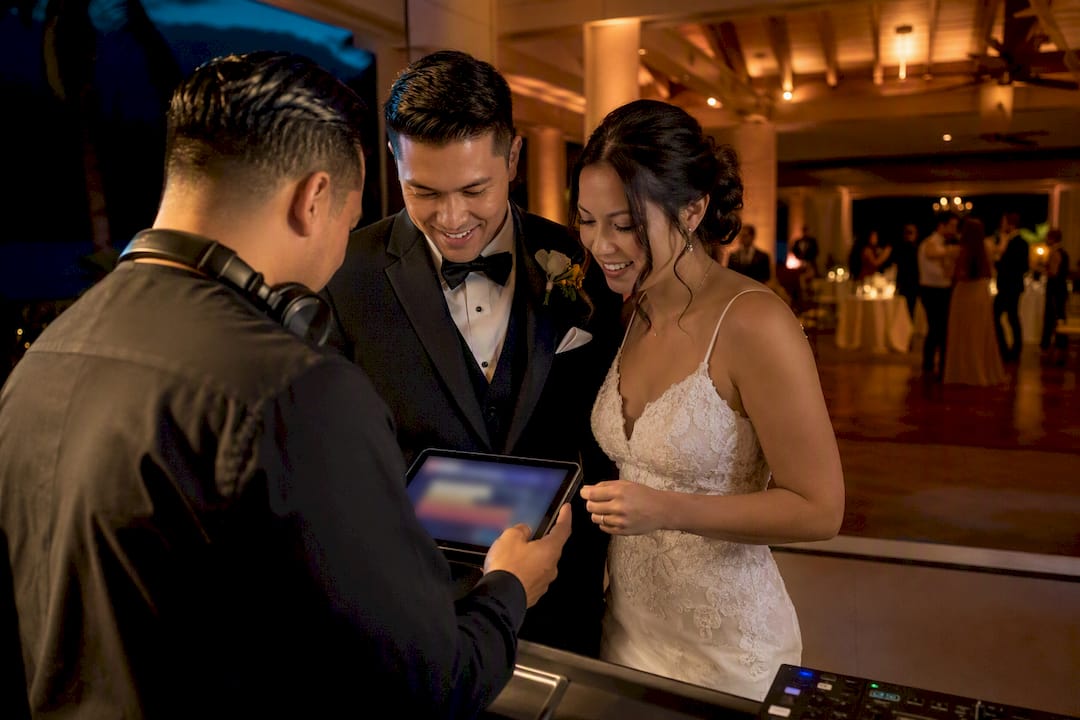
A wedding do-not-play list is a written record of songs and categories you want banned from your reception, and the best ones run 10 to 20 hard-ban tracks plus a few soft-ban genres you’d rather your DJ avoid unless the floor demands it. Give this list, along with your must-play songs, to your DJ or band several weeks before the wedding, then confirm it one to two weeks out. That timing gives your entertainer room to plan the night’s energy instead of scrambling last minute.
TL;DR:
Hard bans should be limited to 10 to 20 songs to avoid restricting the DJ’s ability to adapt to guest energy.
Specific banned songs often include overplayed crowd clichés like “The Chicken Dance” and “Macarena,” and viral hits like “Gangnam Style.”
Lists should distinguish between non-negotiable hard bans and soft bans the DJ can override if the dance floor is lagging.
Include cultural, family, or personal sensitivities in the list to prevent awkward or unwanted requests during the reception.
Submit your finalized detailed list four to six weeks before the wedding and clarify that the DJ is authorized to decline requests conflicting with your bans.
Table of Contents
The Wedding Do-Not-Play List: Songs to Ban and Why
Every overplayed wedding song earns its bad reputation somehow. Grouping them by reason makes it easier to decide which ones actually matter to you, because not every couple needs to ban the same things.
Line-dance and crowd-cliché songs. These get requested at every reception because someone’s aunt loves them, but they also stop real dancing cold and turn your floor into a group exercise class.
“The Chicken Dance” — Guests either love it or physically avoid it; there’s rarely middle ground.
“The Electric Slide” — Feels more like a gym class than a party.
“Cha Cha Slide” by DJ Casper — Instructions instead of dancing.
“Macarena” — A 1996 hit that still shows up on 2026 wedding blacklists, according to The Knot.
“YMCA” by Village People — Fun at a bar, forgettable at your first dance set.
“Cotton Eye Joe” — Clears floors as fast as it fills them.
Overplayed radio hits and novelty tracks. These songs date a reception the moment the DJ hits play, and they tend to say more about a wedding year than about you as a couple.
“Gangnam Style” by PSY — A viral moment that’s now a punchline.
“Who Let The Dogs Out” by Baha Men — Novelty that never grew into a classic, per The Knot’s list of 26 do-not-play songs.
“All Star” by Smash Mouth — Beloved by memes, exhausting on a dance floor.
“Wobble” — A line dance disguised as a hit single.
Songs with negative or awkward lyrical themes. These are trickier because the melody sounds fine until you actually listen to the words during your first dance or a slow set. Brides points out that couples often ban these to keep the mood focused on celebration, not heartbreak.
“Every Breath You Take” by The Police — A stalking anthem mistaken for a love song.
“I Will Always Love You” by Whitney Houston — Beautiful vocally, but it’s a breakup song.
“Before He Cheats” by Carrie Underwood — Great karaoke, terrible wedding subtext.
“Someone Like You” by Adele — Gorgeous heartbreak ballad, wrong room.
Explicit or NSFW tracks. If grandparents, kids, or coworkers will be in the room, explicit lyrics create an awkward scramble for the mute button. Reports covered by The New York Times note couples increasingly ask DJs to avoid tracks like “Blurred Lines” and “WAP” specifically for this reason, regardless of how popular they are on the radio.
How to Build a List That Still Keeps the Floor Packed
A do-not-play list works best when it does two jobs at once: it protects the moments that matter to you, and it still leaves your DJ enough room to read 150 dancing strangers in real time. That balance comes down to how you structure the list, not how long it is.
Split bans into hard and soft. Hard bans are non-negotiable, no matter how loud the request table gets. Soft bans are “avoid unless the floor is dying” categories the DJ can override at their discretion.
Name actual songs, not vague rules. “No country” tells your DJ nothing useful. “No ‘Cotton Eye Joe’” does. Save genre or era bans (like “nothing pre-1990”) for situations where a specific title truly won’t cover it.
Use a Spotify playlist to plan, but submit a written list as the real document. A shared playlist is great for brainstorming with your partner, but TheEvore recommends handing your DJ a written setlist with clear must-play and do-not-play sections, since that’s the version they’ll actually work from on the night.
Cap your hard bans around 10 to 20 songs. Beyond that, you start handcuffing the person whose entire job is adjusting to the room in real time.
If you’re still deciding whether to hire a DJ or build your own playlist, this comparison of DJs versus playlists breaks down which option fits a 150-guest reception versus an intimate backyard one.
When to Hand Your DJ the List (and What to Include)
Deliver your written must-play and do-not-play lists 4 to 6 weeks before the wedding. That gives your DJ or band enough lead time to plan the night’s energy arc instead of reacting to a list dropped on them the week of the event. Then schedule a short confirmation check-in 1 to 2 weeks out to lock in any last changes.
A complete handoff should include:
Must-play list (10 to 15 songs)
Do-not-play list (10 to 20 songs, sorted hard versus soft)
A quick description of your crowd (age range, dance energy, cultural mix)
A reception timeline with cue points (entrance, toasts, cake, last dance)
A few vibe words (“upbeat,” “classy,” “high energy after 9 p.m.”)
An announcement script if you want specific wording used
Any song dedications tied to specific people or moments
Tell your DJ directly that they have permission to decline requests that appear on your hard-ban list, even under pressure from an enthusiastic guest or a $20 tip. That instruction protects both of you from an awkward moment on the dance floor. For more on what a full vendor briefing should look like, this guide on choosing a wedding reception DJ walks through the questions worth asking before you book.
Pro Tip: Label every entry on your list as “hard ban” or “soft ban,” and add a short reason where it matters. “Hard ban, played at my parents’ divorce reception” tells your DJ everything they need to know without a follow-up call.
Copy-Paste Templates You Can Send Tonight
Here’s a short version and a longer version, ready to paste into an email or a vendor portal.
Short DNP template (10 slots): List the song title and artist for each hard ban, one per line, with no explanation needed unless something feels sensitive to you.
Extended template (20 slots): Same format, but split into two sections labeled “Hard Bans” and “Soft Bans (DJ discretion).”
Sample message to your DJ: Subject line: “Music Notes for [Your Names]'s Wedding.” One paragraph stating your vibe, your must-play priorities, and a note that the attached list is final unless you follow up. Attach both lists as a single document, not two separate files.
Optional RSVP wording: If you want guest input, try: “Have a song you love? Send it our way. Just know a few tracks are off the table for us, so our DJ may not be able to take every request.”
Keep both documents in one file. A DJ juggling a printed must-play sheet and a separate mental list of bans is far more likely to slip than one working from a single page.
What Real Couples Actually Ban
Reporting from The New York Times found some couples submitting dozens of restrictions to their DJs, driven by everything from personal breakup history to broader discomfort with a song’s message. One recurring example: couples specifically flagging “Blurred Lines” for removal, years after its release, because its lyrics read very differently in 2026 than they did when it topped the charts.
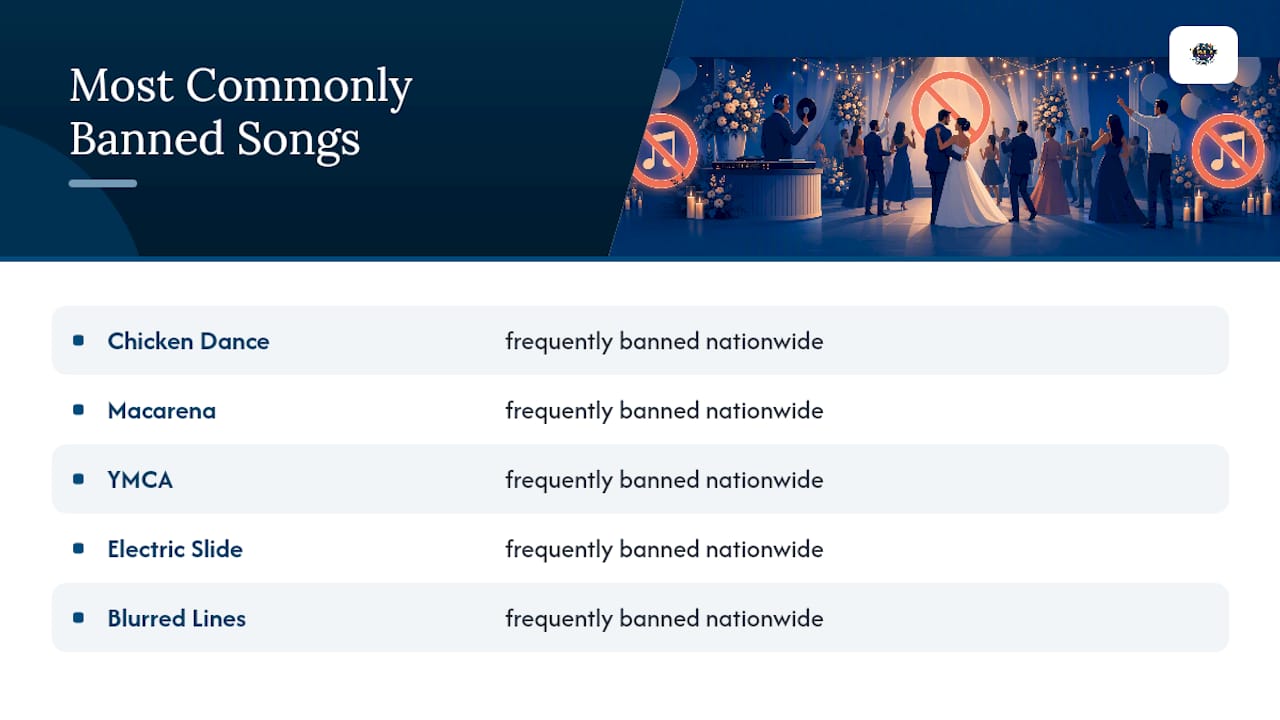
Aggregated blacklists compiled by wedding vendors tend to repeat the same names over and over. Lists compiled by regional entertainment companies, including one covering 48 commonly banned songs, consistently flag “Chicken Dance,” “Macarena,” “YMCA,” “Who Let The Dogs Out,” “Electric Slide,” and “Blurred Lines” as the most frequent bans nationwide. That consistency is useful: if you’re short on time, starting from this shared list and removing anything you actually like gets you to a working DNP list in minutes.
Some couples go further and ban an entire genre for a portion of the night, like keeping cocktail hour free of anything with a heavy dance beat. That’s less about any one song and more about pacing, which matters just as much as the blacklist itself.
Revisit Your List Before the Big Day
Your do-not-play list isn’t a document you write once and forget. Confirm it again 1 to 2 weeks before the wedding, right alongside your final headcount and timeline. Guest lists shift, family dynamics change, and a song that felt fine in month one of planning can suddenly feel wrong once you know who’s actually sitting at table six.
This final check is also when you should ask your DJ directly whether anything on your list conflicts with your reception timeline. A soft ban on “nothing too slow before 8 p.m.” only works if your DJ knows your dinner service is running late. Treat the confirmation call as a two-way conversation, not a rubber stamp.
If your wedding party or vendor team changes between your first draft and the final week, a quick refresh keeps everyone working from the same page. Sending an updated PDF with a clear “FINAL” label in the file name avoids any confusion about which version is current.
Handling Family and Cultural Music Requests
Your do-not-play list isn’t only about musical taste. It’s also where you handle the family dynamics that come with a big shared event. If a certain song played at a difficult moment in your family’s history, your DJ needs to know that before the reception starts, not while a well-meaning relative is requesting it on the dance floor.
Cultural and religious considerations belong here too. Some families expect specific songs for a first dance, a parent dance, or a cultural entrance, while others want to skip those traditions entirely. Write both directions down. Telling your DJ “no traditional entrance music, please” is just as useful as telling them what you do want.
If you’re blending two families with different musical backgrounds, use your must-play list to represent both sides intentionally, and let your do-not-play list catch anything that might create tension, whether that’s a song tied to a past relationship or one associated with a strained family relationship. A written list takes the pressure off you to explain these decisions in person on the wedding day itself.
How Professionals Read a Do-Not-Play List
A do-not-play list isn’t paperwork filed away. It’s a working document that DJs, photobooth, and karaoke teams actually reference throughout the reception, because the goal is the same one you have: a full dance floor and zero awkward moments.
Hard bans get treated as final, no exceptions, no matter how many guests ask. Soft bans give entertainers room to read the crowd and make a judgment call in real time, which is exactly the flexibility a good DJ needs to keep momentum going late into the night.
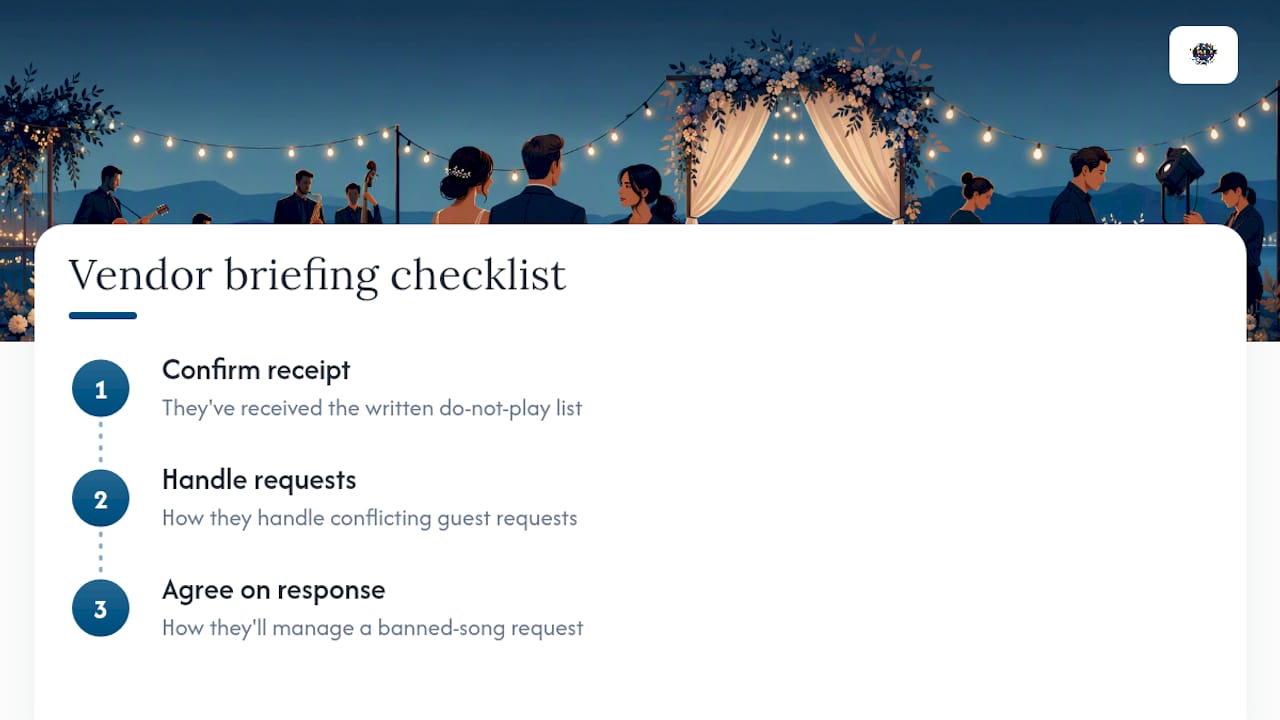
A quick vendor briefing checklist worth using with any live entertainment provider: confirm they’ve received your written list, ask how they handle guest song requests that conflict with it, and get a straight answer on how they’ll manage a difficult moment if someone requests a banned song anyway.
Book Your Reception Music with a Team That Actually Uses Your List
Some event entertainment providers offer DJ sound and lighting, photobooth, karaoke, and timeline coordination for weddings, all built around the do-not-play and must-play lists you provide at booking. That’s an advantage: instead of hoping a hired DJ remembers your notes, you get a team that treats your list as the plan for the night, not a suggestion.
We ask every couple for a written list 4 to 6 weeks out, confirm it with you closer to the date, and hold the line on hard bans even when a guest offers to sweeten the request. Our teams handle everything from cocktail-hour pacing to late-night dance sets, and mix-and-match packages mean you can pair DJ services with our photobooth rentals or karaoke setup without booking separate vendors. Want to see how past receptions came together? Browse our event gallery for a look at real setups, then reach out to check availability for your date and get a quote tailored to your guest count and venue.
Sources
FAQ
What are good do-not-play songs for a wedding?
Common bans include “The Chicken Dance,” “Macarena,” “Electric Slide,” “YMCA,” and songs with breakup or infidelity themes like “Before He Cheats,” according to The Knot.
What are the top songs not to play at a wedding?
The most frequently banned tracks nationwide are “Chicken Dance,” “Macarena,” “YMCA,” “Who Let The Dogs Out,” “Electric Slide,” and “Blurred Lines,” based on aggregated vendor blacklists.
What is the rule some DJs use for reading the room?
Experienced entertainers build energy gradually through the night and reserve high-energy dance songs for the main dance window, rather than peaking too early during dinner or cocktail hour.
How long should a do-not-play list be?
Aim for 10 to 20 hard-ban songs. Lists that run much longer than that start limiting your DJ’s ability to adjust to the crowd in real time.
When should I send my do-not-play list to my DJ?
Send your written must-play and do-not-play lists 4 to 6 weeks before your wedding, then confirm any final changes 1 to 2 weeks out.
Recommended
This article was created with the assistance of AI and reviewed for relevance and accuracy by Terriffics Entertainment. Information may change over time, so readers should verify important details with the appropriate local source.
Comments