
_edited.png)

What Is a Professional Event Team? Roles and Benefits


A professional event team is a coordinated group of skilled specialists who manage every aspect of an event, from initial concept through post-event evaluation. The U.S. Bureau of Labor Statistics defines this function as applying project management principles across 5–10 distinct workstreams, including budgeting, vendor sourcing, and attendee communication. Unlike ad hoc staffing, a structured event management team assigns clear roles, follows defined phases, and delivers consistent results. Whether you are planning a wedding in Kapolei or a corporate gathering on Oahu, knowing what a professional event team does helps you make smarter hiring decisions and set realistic expectations.
What is a professional event team and how is it structured?
A professional event team is a structured group of specialists, each owning a defined function within the event planning and execution process. The industry term for this function is “event management,” and the team is the operational unit that makes it work. Every member has a specific scope of responsibility, a reporting line, and measurable deliverables. That structure is what separates a professional event team from a group of volunteers or temporary workers assembled at the last minute.
The roles in event management typically fall into six core functions. Each function covers a distinct area of the event, and together they form a complete operational picture.

Role | Core Responsibility | Key Skill |
Event Manager | Oversees all workstreams and client communication | Leadership, decision-making |
Logistics Coordinator | Manages vendors, timelines, and venue setup | Organizational planning |
Technical Lead | Controls AV, lighting, and equipment | Technical troubleshooting |
Finance Manager | Tracks budget, negotiates costs, and reconciles spend | Financial analysis |
Marketing Lead | Handles promotion, registration, and attendee outreach | Digital marketing |
Guest Services Lead | Manages check-in, attendee flow, and onsite experience | Customer service |
Defined roles like Finance Manager and Technical Lead reduce event chaos and improve onsite issue resolution speed by over 50%. That number reflects a simple truth: when everyone knows their lane, problems get solved faster and guests never notice them.
How does a professional event team operate throughout the event lifecycle?
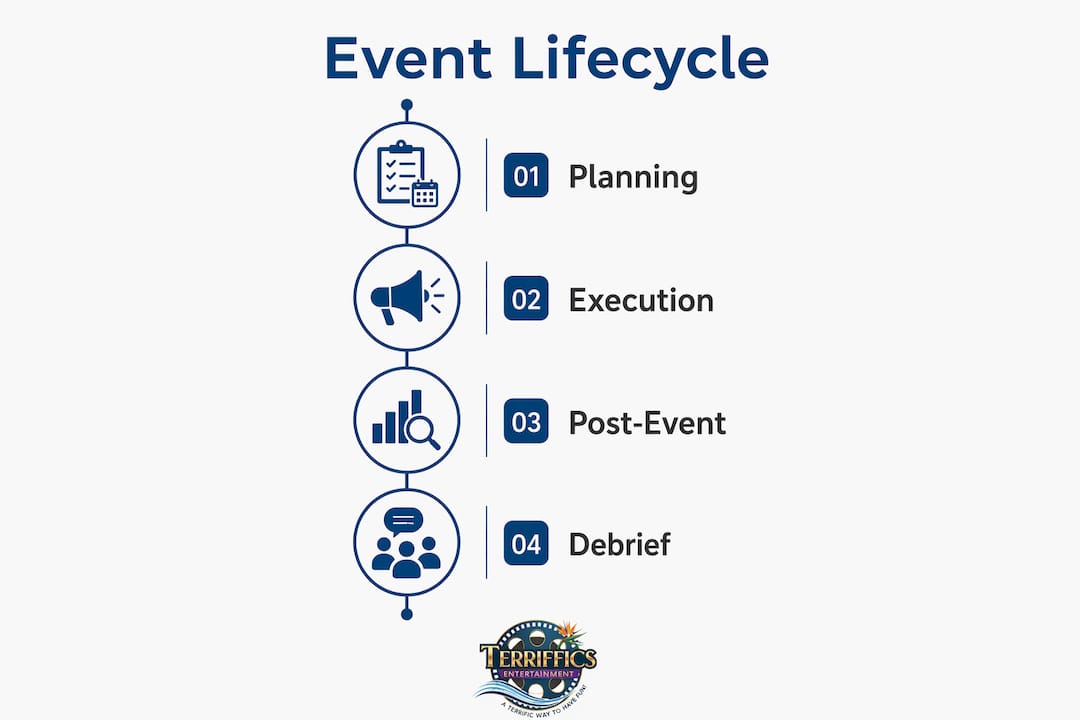
A professional event team works in three distinct phases: planning, execution, and post-event evaluation. Each phase has its own priorities, intensity level, and deliverables. Understanding this lifecycle helps you appreciate why event coordination specialists charge for time well before the event date.
The planning phase
The planning phase covers budgeting, vendor negotiation, timeline creation, and risk assessment. This phase can span weeks or months depending on event scale. The team builds the operational blueprint that every other phase depends on. Teams spend 80% of their time in pre-emptive planning so that event-day issues are minimal and invisible to attendees. That investment is where the real value of professional event services lives.
The event-day sprint
Event day is the highest-intensity phase. The team shifts from planning mode into real-time coordination, troubleshooting, and decision-making. A clear chain of command empowers staff to make real-time decisions without waiting for client approval, which prevents bottlenecks during the event-day sprint. Every minute of delay at a live event is visible to guests, so speed of resolution matters.
Key event-day activities include:
Coordinating vendor arrivals and setup against the master timeline
Managing guest check-in flow and seating logistics
Monitoring AV and technical systems throughout the program
Communicating status updates across the team via radio or messaging apps
Resolving unexpected issues before they reach the client or guests
The post-event phase
Post-event work is often underestimated. Professionals invest significant time in final vendor payments, budget reconciliation, and lessons learned documentation. This phase typically accounts for 20–30% of total project time. That documentation feeds directly into ROI analysis and makes the next event easier to plan and execute.
Pro Tip: Build your post-event debrief into the project timeline before the event starts. Teams that schedule a debrief within 48 hours of the event capture more accurate feedback and close out vendor payments faster.
What practical benefits does hiring a professional event team bring?
Hiring a professional event team delivers benefits that go well beyond having extra hands on site. The most measurable advantage is budget protection. Professional planners protect budgets through negotiation and cost-saving measures that often offset their management fees entirely. That means the team frequently pays for itself before the event even happens.
Here are the core benefits that separate professional event teams from temporary or ad hoc staffing:
Faster issue resolution. Structured teams resolve onsite problems before guests notice them, thanks to defined roles and clear decision authority.
Budget discipline. A dedicated Finance Manager tracks every line item and flags overruns early, not after the invoice arrives.
Vendor accountability. Professional teams have established relationships with vendors and know how to hold them to contract terms.
Guest experience focus. A Guest Services Lead monitors attendee flow and comfort throughout the event, so you can focus on being a host rather than a problem solver.
Risk preparedness. Professional teams anticipate minor but critical logistical issues and arrive with solutions already in hand.
Pro Tip: Ask your event team what they carry in their emergency kit. A well-prepared team brings gaffer tape, power strips, extra batteries, and a printed backup of the run-of-show. If they look confused by the question, that tells you something important.
Professional teams balance client goals, attendee comfort, and venue logistics without requiring constant client input. That balance is what allows you to enjoy your own event instead of managing it.
How to build and manage your event planning team effectively
Building a strong event planning team starts with a clear assessment of your event’s specific needs. A birthday party on the beach requires a different team composition than a 300-person corporate conference. Start with scope, then assign roles.
Follow these steps to build and manage your team well:
Define your event scope first. List every function the event requires, from AV and catering to guest registration and photography. That list becomes your staffing map.
Assign one owner per function. Avoid shared ownership of tasks. When two people own the same responsibility, neither one does it fully.
Create a written communication structure. Decide who reports to whom, how updates are shared, and what triggers an escalation. A simple org chart prevents confusion on event day.
Use a shared event schedule workflow tool. A shared timeline or project management board keeps everyone aligned without requiring constant check-in meetings.
Schedule a pre-event walkthrough. Walk the venue with your full team at least 48 hours before the event. Identify gaps, confirm logistics, and assign contingency roles.
Evaluate performance after every event. Use a short debrief form to capture what worked, what did not, and what to change. That feedback loop is how good teams become great ones.
An event planning checklist is one of the most practical tools for keeping your team aligned across all phases. Use one for every event, regardless of size.
Key Takeaways
A professional event team is the single most effective way to protect your budget, reduce onsite chaos, and deliver a consistent guest experience across every phase of an event.
Point | Details |
Structured roles reduce chaos | Defined roles like Technical Lead and Finance Manager cut issue resolution time significantly. |
80% of value is in planning | Teams invest most of their time before event day, making problems invisible to guests. |
Post-event work drives ROI | Budget reconciliation and lessons learned documentation are critical for future event success. |
Budget protection is built in | Professional negotiation and cost management often offset the team’s management fees. |
Clear command prevents bottlenecks | Empowering staff with decision authority keeps event-day operations moving without client intervention. |
Why I think most people underestimate what a professional event team actually does
The biggest misconception I see is that event planners just book vendors and show up on the day. That framing misses almost everything that matters. The real work happens in the weeks before the event, in the vendor contracts, the contingency plans, and the 6:00 AM venue walkthrough that guests never see.
What surprises most clients is how much of the team’s value is invisible. When an event runs perfectly, nobody thinks about the logistics coordinator who confirmed the caterer’s arrival window three times or the technical lead who tested every microphone the night before. That invisibility is the goal. It means the team did their job.
The other thing I have learned is that empowering your team with real decision authority is non-negotiable. A team member who has to call the client for every small decision will slow everything down. Give your team a clear brief, defined boundaries, and the authority to act within them. That is how you get an event that feels effortless to everyone in the room.
If you are organizing a celebration or corporate event on Oahu, invest in a team that has done this before. The structure, the preparation, and the professionalism are worth every dollar.
— Terriffics
Terrifficsentertainment can make your next event unforgettable
Planning a celebration on Oahu and want professional entertainment that shows up ready to perform? Terrifficsentertainment brings DJ sound and lighting, karaoke, outdoor movie setups, and an AI-powered photobooth rental to weddings, graduations, birthdays, and corporate events across the entire island. We handle fast setup and teardown so your team can focus on the guest experience.
Our mix-and-match packages let you customize your entertainment without overcomplicating your planning process. Every service we offer is designed to fit cleanly into your event timeline and work alongside your existing team. Book or get a quote today and let us handle the fun.
FAQ
What is a professional event team?
A professional event team is a structured group of specialists who apply project management principles to plan, execute, and evaluate events. The U.S. Bureau of Labor Statistics recognizes event planning as a distinct profession managing multiple workstreams simultaneously.
What do event planners do on a daily basis?
Event planners coordinate vendors, manage budgets, build timelines, and communicate with clients and venues. On event day, they shift to real-time troubleshooting and logistics coordination to keep the program running on schedule.
How many people does a professional event team need?
Team size depends on event scope and complexity. A small celebration may need three to four specialists, while a large corporate event can require six or more dedicated roles covering logistics, AV, finance, and guest services.
What is the difference between a professional team and temporary event staff?
Temporary staff fill labor gaps on event day, while a professional event team owns the full lifecycle from planning through post-event evaluation. Professional teams bring accountability, vendor relationships, and budget management that temporary workers do not provide.
When should I start building my event planning team?
Start assembling your team as early as possible, ideally several months before the event date. The planning phase alone can take weeks, and early team formation gives you more time for vendor negotiation, timeline building, and contingency planning.
Recommended
Comments