
_edited.png)

Before You Book Karaoke in the U.S., Ask These 6 Licensing Questions


Yes, hiring a karaoke rental service that supplies both equipment and commercially licensed karaoke tracks is a practical choice for most U.S. event hosts. It covers the gear (speakers, mics, screens, song catalog) and puts the licensed music access in the provider’s hands instead of yours. Some companies build this into their packages, so the real work for you is asking the right questions before you sign.
TL;DR:
Booking a licensed karaoke rental service ensures access to a large catalog of commercially licensed tracks, avoiding legal risks and licensing issues.
Most providers include an operator, a full setup suited to the venue size, and backup equipment to ensure smooth event flow.
Cost is typically included in a flat rate or hourly fee, with bundling options available for combining karaoke with DJ or photo booth services for better value.
Asking detailed questions about the music catalog, licensing, and contingency plans helps prevent misunderstandings and ensures event success.
Using unlicensed karaoke tracks online exposes hosts to copyright violations and potential legal penalties, making licensed services the safest choice.
Table of Contents
What Does a Karaoke Rental Service Actually Provide?
A karaoke rental booking should hand you a working system, not a box of cables. Most providers deliver a full setup and manage the music library on their end, which is the whole point of hiring one instead of renting a machine from a big-box store.
Here’s what a solid karaoke package typically includes:
A PA system sized to the room or venue (speakers, mixer, amplifier)
Two or more wireless or wired microphones with backups on hand
A screen or monitor showing lyrics and a song-request interface for guests
Access to a music catalog, either through a streaming service, a local hard drive library, or curated USB playlists
An operator or host who runs the queue, or a self-serve setup with simple instructions
Music access models vary by provider. Some run a subscription-based streaming catalog with a very large number of tracks available. Others maintain a local library loaded onto a dedicated laptop or media player, which helps in venues with weak Wi-Fi. A few offer both, switching to local files as a backup if the internet drops mid-party.
“Licensed music included” means the provider has already secured the rights to use those commercial tracks in a public performance setting, so you’re not sourcing karaoke files from questionable corners of the internet. Terriffics Entertainment’s karaoke rental packages fold this access into the booking, whether you go with the [Small Karaoke Package] or the Big Karaoke Package.
What Should You Ask Before Booking Karaoke Rental?
The quote you get back tells you a lot, but only if you ask the right questions first. Vendors who supply commercially licensed catalogs are usually happy to explain how their system works. Hesitation on these points is a signal to keep looking.
What’s in the song catalog, and how is it delivered? Ask whether it’s a live streaming library, a local file library, or both, and roughly how many titles are available.
Who holds the licensing or subscription, and can you show it? A vendor supplying commercial karaoke tracks should be able to describe their access model without dodging the question.
Is an operator included, or is this drop-off equipment? Staffed events run smoother, especially with a large guest list or an open floor plan.
How many microphones come standard, and what’s the backup plan if one fails?
What’s the setup and teardown window, and does it fit your venue’s access hours?
What happens if the event runs long, gets rained out, or gets canceled? Ask about overtime rates, weather contingencies, and cancellation terms in writing.
Terriffics Entertainment’s guide on booking karaoke rental without stress walks through these exact checkpoints, including deposit timing and what belongs in a contract before you sign it.
How Much Does Karaoke Rental Typically Cost?
Most karaoke rental providers price by flat package or by the hour, and knowing which model you’re looking at changes how you compare quotes. Flat packages usually cover a set block of time (say, three or four hours) with a defined equipment list. Hourly pricing gives you more flexibility for shorter or longer events but can add up fast if the party runs late.
Several factors push a quote up or down:
Event length and whether it’s a straightforward evening party or a multi-hour wedding reception
Travel distance and setup complexity (stairs, outdoor power access, tight load-in spaces)
Number of microphones and whether a live operator is included
Peak dates, since Friday and Saturday nights in busy seasons often carry a premium
Add-on bundles, like combining karaoke with a DJ setup or a photobooth, which often knock down the per-service cost compared to booking each separately
When a quote comes back, ask for an itemized breakdown rather than a single lump number. A clear quote should spell out equipment, hours, operator presence, and a line confirming the provider supplies its own licensed catalog access, not tracks you’d need to source yourself.
Pro Tip: Ask about bundling karaoke with a DJ or photobooth package before you book them separately. Vendors that offer mix-and-match services, like Terriffics Entertainment’s combined DJ and karaoke setups, often price the bundle lower than two standalone bookings, and you deal with one setup crew instead of two.
What Happens on Karaoke Setup Day?
A good vendor arrives with enough buffer to test everything before your first guest walks in. Here’s a realistic timeline for how the day should unfold.
Arrival and setup window. Most providers plan for a moderate setup time depending on the venue, arriving well ahead of your start time rather than cutting it close.
Soundcheck. Mics get tested for levels and feedback, monitors get positioned so singers can hear themselves without blasting the front row, and the screen gets checked for visibility across the room.
Technical backups confirmed. A reliable operator carries spare cables, backup mics, and an offline song queue in case the internet connection drops.
Point person designated. Name one person, whether that’s you, a wedding planner, or an event coordinator, as the go-between for song requests and timing questions.
Song-request workflow set. Decide upfront whether requests go through a paper list, a digital queue, or the operator directly, so there’s no confusion once the singing starts.
Open mic time managed. If it’s a party with a long guest list, the operator should pace turns so everyone who wants to sing gets a shot.
Terriffics Entertainment’s own setup essentials checklist covers these confirmation points in more depth, and its guide to organizing a karaoke party that flows has practical tips for keeping the mic moving.
What Does Terriffics Include in Its Karaoke Packages?
Terriffics Entertainment builds its karaoke rentals around the same principle this whole guide is based on: equipment and licensed music access bundled into one booking so hosts on Oahu aren’t juggling separate vendors. The Small Karaoke Package and Big Karaoke Package scale to fit anything from a backyard birthday to a larger community gathering, and both can combine with DJ sound and lighting for events that need more than a microphone and a screen.
Fast setup and teardown matter more than people expect until they’ve watched a slow crew eat into party time. Terriffics prioritizes quick turnaround so guests aren’t standing around waiting for a system to boot up. The company has documented real event logistics in pieces like its West Oahu karaoke event example, which shows how setup, song flow, and guest turnout play out in practice.
How Do US Music Licensing Laws Apply to Karaoke?
Public performance of copyrighted music in the United States is governed by federal copyright law, and karaoke tracks are no exception. When a venue, business, or event plays commercial music (including the backing tracks used for karaoke) in a setting open to the public, that performance generally requires permission from the rights holder or a licensing body acting on their behalf.
This is the legal backbone behind why “licensed karaoke tracks” is a meaningful phrase rather than marketing language. Commercial karaoke track producers negotiate rights to reproduce and distribute portions of popular songs in karaoke format, and venues or providers using those tracks in public settings need their own layer of permission for the public performance itself. The law draws a real distinction between owning a karaoke disc or file and having the right to perform it publicly.
For event hosts, the practical upshot is simple: when you book a provider that says its catalog is commercially licensed, you’re relying on that company’s underlying agreements with music rights holders and licensing organizations. That’s a meaningfully different position than downloading karaoke tracks from an unverified source and using them at a public event, which sidesteps the licensing chain entirely.
Performance Rights vs. Mechanical Rights: What’s the Difference?
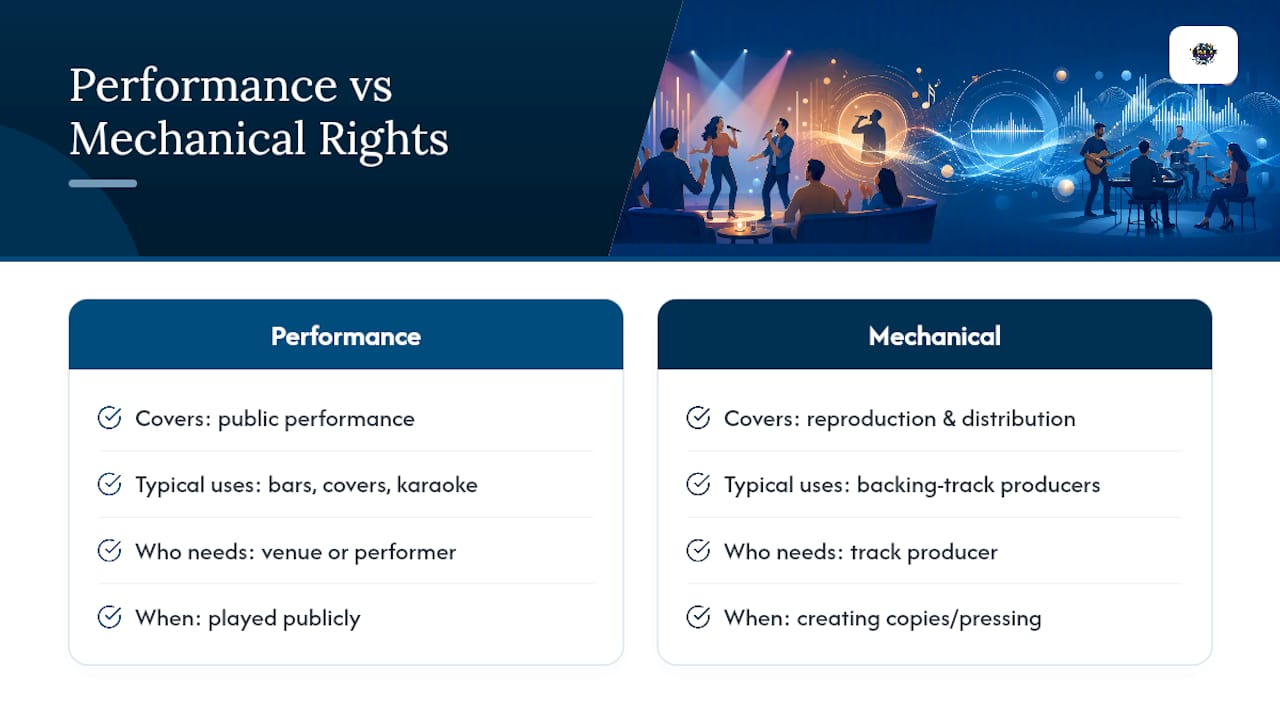
Two separate kinds of permission apply to recorded music, and karaoke touches both. Performance rights cover the act of playing a song publicly, whether that’s a bar’s speakers, a live band’s cover, or a karaoke track pumped through a PA system at a wedding reception. Mechanical rights cover the reproduction of a song, meaning the right to press, copy, or distribute a recording, which is what a karaoke track manufacturer needs to legally produce backing tracks in the first place.
These two rights sit at different points in the chain. A karaoke track producer secures mechanical rights (and often a synchronization license) to legally create the instrumental or backing version of a song. Whoever plays that track in a public setting is exercising a performance right, which is a separate permission entirely. Owning a legally produced karaoke disc doesn’t automatically clear you to perform it in a bar or event hall; that’s a different piece of the licensing puzzle.
This distinction is why some vendors talk about “licensed catalogs” without much elaboration. A provider handling music licensing responsibly typically has both bases covered: legally produced tracks and the performance clearance to use them at events. As a host, you don’t need to become a copyright expert. You need a vendor who can speak plainly about which rights their catalog access actually covers.
Which Organizations Handle Music Licensing in the USA?
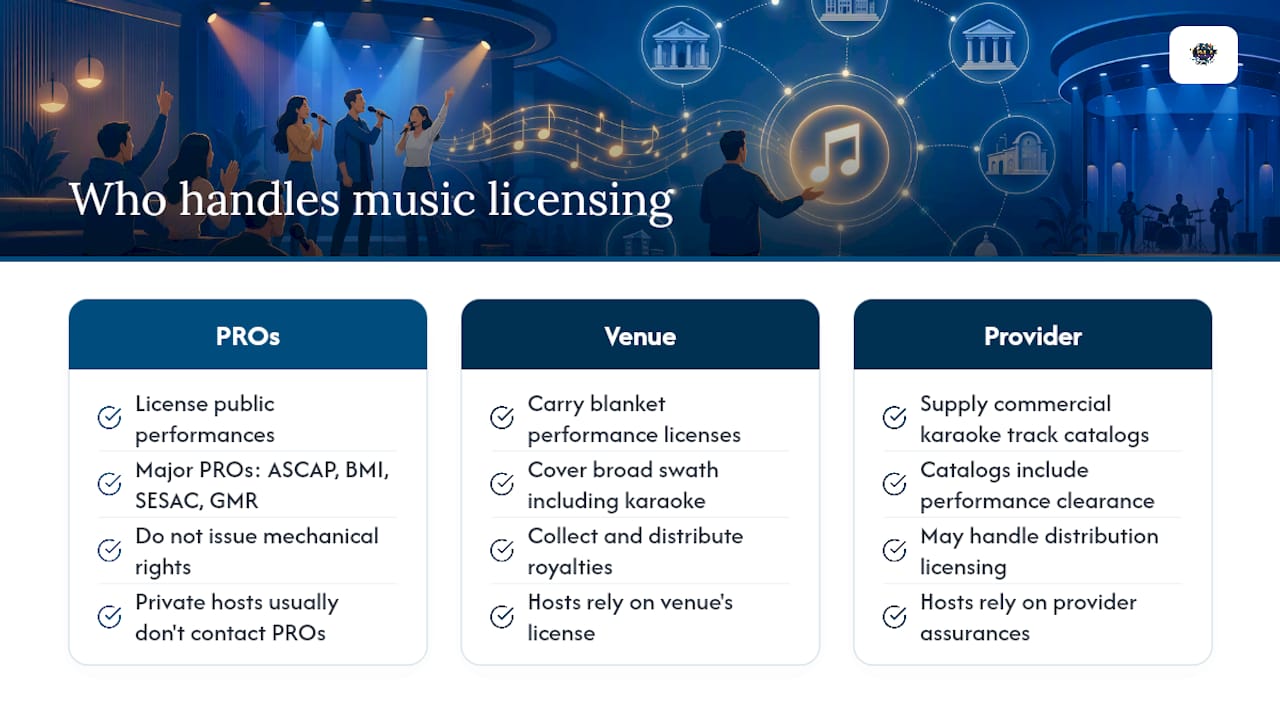
Performance rights organizations, commonly called PROs, are the entities that license the public performance of music on behalf of songwriters and publishers. In the United States, the major PROs are ASCAP, BMI, SESAC, and GMR. Venues, bars, and businesses that regularly play music, including karaoke, often carry a blanket license from one or more of these organizations covering the performance side of things.
These organizations don’t typically issue the mechanical rights or manufacture karaoke tracks themselves. Their role is collecting royalties on public performances and distributing them to the songwriters and publishers whose catalogs get played. A venue with an ASCAP or BMI license is covered for a broad swath of the music that gets performed on its premises, karaoke tracks included.
For most private hosts booking a one-off event, direct dealings with a PRO aren’t part of the picture. That responsibility tends to sit with the venue (if the event happens somewhere with a standing license) or with the karaoke provider, whose commercial track catalog should already account for the performance clearance built into how those tracks were licensed for distribution. This is exactly why the vendor questions in the earlier checklist matter: a provider who can speak clearly about how their catalog was licensed has done that homework already.
What Are the Risks of Unlicensed Karaoke Music?
Using unlicensed karaoke tracks at a public event carries real exposure, and it isn’t a hypothetical. Copyright holders and the PROs that represent them actively monitor and enforce licensing compliance, and venues have faced legal action and financial penalties for playing music, including karaoke, without proper clearance.
The consequences aren’t limited to the venue. A karaoke operator or host who sources bootleg tracks and performs them publicly can also carry liability, since copyright infringement doesn’t require malicious intent, only unauthorized use. Cease-and-desist letters, statutory damages, and settlement demands are all realistic outcomes for repeat or flagrant violations, particularly for businesses that host karaoke on a recurring basis rather than a single private party.
This is the practical argument for booking a provider whose catalog is commercially licensed rather than assembling your own karaoke files from free download sites. It shifts the licensing burden onto a company whose business model depends on getting that piece right, rather than leaving a host or small venue exposed to a dispute they never saw coming.
Do Private Parties Need the Same Licensing as Public Events?
Licensing exposure generally scales with how public and commercial the event is. A private, invite-only party at someone’s home, with no cover charge and no public advertising, sits in a different category than a bar running a weekly karaoke night open to any paying customer walking in off the street.
Public and commercial settings carry more exposure because copyright enforcement is largely built around the concept of public performance. A recurring karaoke night at a restaurant, a corporate event with paying attendees, or a fundraiser open to the general public all look more like the kind of public performance that licensing rules are designed to cover.
That said, “private” isn’t a blanket exemption, and the safest approach for any event, private or public, is booking a provider whose catalog is already commercially licensed. It removes the guesswork entirely instead of relying on an assumption about where a particular gathering falls on the private-to-public spectrum.
What Do Licensing Costs Typically Look Like for Hosts?
For the individual event host booking a one-off karaoke rental, licensing costs aren’t usually a separate line item you pay directly. Instead, that cost is baked into the provider’s rate, since the vendor has already covered the licensing overhead of building a commercially cleared catalog.
Venues that host karaoke regularly are a different story. A bar or restaurant running a standing karaoke night may need its own blanket performance license from a PRO like ASCAP or BMI, priced based on factors like venue capacity, how often music is performed, and whether it’s a subscription-style annual fee. Those costs sit with the business operating the venue, not with a guest attending a party there.
For most readers planning a single wedding, birthday, graduation, or corporate event, the simplest path is a provider who has already absorbed that licensing cost into their package price. You’re paying one rate for equipment, an operator, and a legally cleared song catalog, rather than piecing together licensing and equipment from separate sources.
What This Guide Gets Right That Most Advice Misses
Most articles on this topic treat licensing like an abstract compliance issue, something to research and worry about in isolation. That framing misses the point for the vast majority of people booking a karaoke night for a wedding, graduation, or backyard party. You don’t need a law degree. You need a vendor who has already done that work and can answer a handful of direct questions without hedging.
The conventional advice tends to overload hosts with legal detail and underload them with the practical checklist that actually protects them: ask about the catalog, ask who holds the rights, get the setup timeline in writing, and confirm contingency plans before you pay a deposit. That’s the part that gets skipped, and it’s the part that actually determines whether your event day goes smoothly.
If there’s one thing to prioritize first, it’s this: pick a provider who talks about licensing plainly and proactively, not one who gets vague when you ask. That single signal tells you more about how the rest of the booking will go than any pricing comparison will.
— Terriffics
Ready to Book Karaoke Rental in Hawaii?
Booking a provider that bundles equipment and a licensed track catalog into one package saves you from chasing down gear, sourcing music, and hoping it all works on event day. This is a beneficial option for event hosts who want that whole equation handled in a single booking instead of piecing together rentals and playlists on their own.
Our Small Karaoke Package and Big Karaoke Package both come with equipment, licensed catalog access, and setup handled by our crew. If your event calls for more than a mic and a screen, our DJ rental packages pair naturally with karaoke for a fuller night, and our photobooth rentals round things out for parties that want more than music. Head to our karaoke rental page to request an itemized quote, and use the vendor checklist above to confirm your catalog and licensing questions before you put down a deposit.
Terriffics Resources for Planning Your Karaoke Event
A few more Terriffics resources go deeper on the logistics covered in this guide:
For general background on how hospitality venues manage inventory and operational licensing, PantryHub’s bar inventory resources offer useful context, though venue-level rules outside the United States won’t apply directly to your event.
FAQ
Does Terriffics Entertainment Include Licensed Karaoke Music?
Yes. Terriffics Entertainment’s karaoke rental packages include equipment and access to a commercially licensed song catalog as part of the booking, so hosts don’t need to source tracks separately.
How Much Does Terriffics Karaoke Rental Cost?
Pricing depends on the package and event details, so current rates for the Small Karaoke Package and Big Karaoke Package are available directly on the Terriffics services page.
Can I Combine Karaoke With a DJ Package?
Yes, and it’s a common way to trim overall cost. Terriffics’ guide on adding karaoke to a DJ package explains how the two services integrate for one combined setup.
What’s the Difference Between Performance Rights and Mechanical Rights?
Mechanical rights cover the right to reproduce or press a recording, which is what karaoke track producers secure to legally manufacture backing tracks. Performance rights cover the right to play that recording publicly, which is a separate permission typically managed through organizations like ASCAP, BMI, or SESAC.
Is It Risky to Use Free Karaoke Files Found Online?
Yes. Unlicensed tracks used at a public event carry real copyright exposure for both the venue and the host, since PROs actively enforce performance licensing. Booking a provider with a commercially licensed catalog removes that risk entirely.
Recommended
This article was created with the assistance of AI and reviewed for relevance and accuracy by Terriffics Entertainment. Information may change over time, so readers should verify important details with the appropriate local source.
Comments